TL;DR
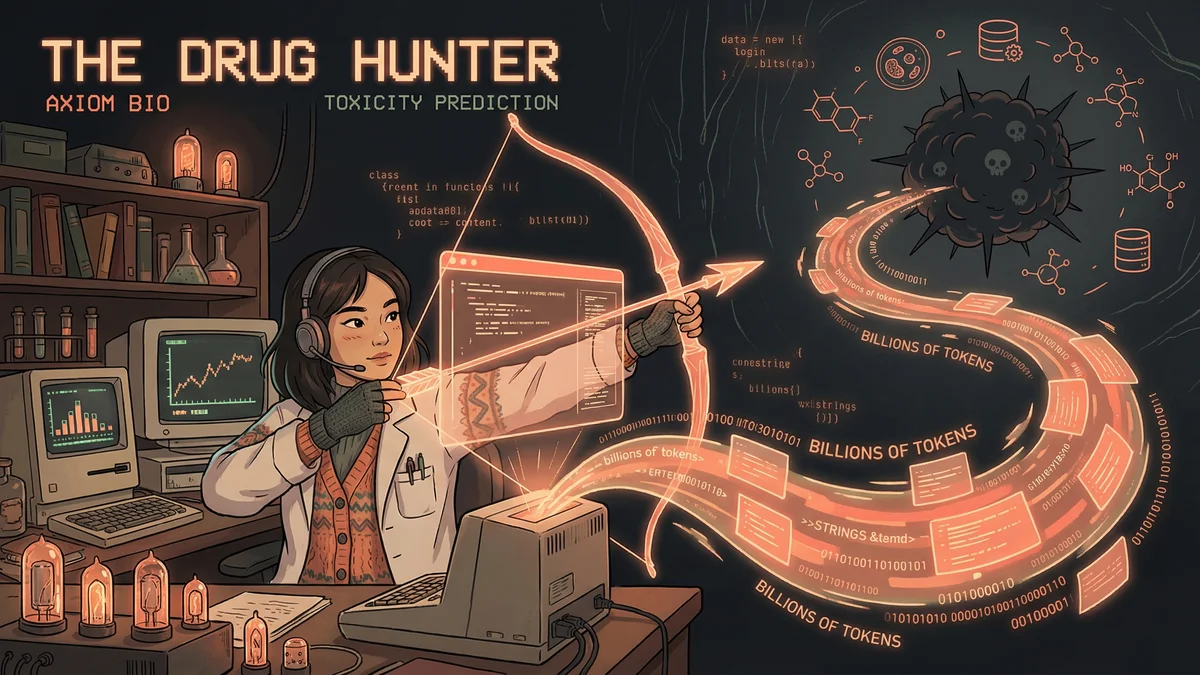
- Axiom Bio predicts drug toxicity computationally before expensive clinical trials
- Billions of tokens processed across weeks of continuous analysis
- MCP servers connect Claude to live biological databases (ChEMBL, PubMed, gene expression)
- Best for: pharma companies wanting to reduce late-stage drug failures
- Key insight: spending thousands on AI analysis can prevent billion-dollar trial failures
A biotech company processed billions of AI tokens to revolutionize drug toxicity research, potentially preventing billion-dollar clinical trial failures by predicting problems computationally.
Drug development fails for many reasons.
Often, it fails because of toxicity. Promising compounds harm patients in ways trials discover too late. Years of work. Billions of dollars. Gone because a side effect wasn’t predicted.
Axiom Bio wanted to predict toxicity earlier. They turned to AI.
The scale of their approach: billions of tokens.
The Toxicity Problem
Traditional toxicity research is slow.
Compounds are tested in cells. Then in animals. Then in humans. Each stage takes months or years. Problems discovered late are expensive.
“By the time you discover toxicity in Phase III trials, you’ve spent hundreds of millions. What if you could predict it computationally, earlier?”
The question was whether AI could analyze biological data at scale and identify toxicity signals.
The Data Landscape
Biological databases contain massive information.
ChEMBL: Millions of compounds with bioactivity data.
PubMed: Millions of research papers on drug effects.
Gene expression databases: How drugs affect cellular activity.
Adverse event databases: Real-world reports of drug problems.
The data existed. No human could read it all. But AI could.
The MCP Connection
Axiom Bio connected Claude to biological databases via MCP servers.
“Claude could directly query ChEMBL. Search PubMed. Pull gene expression data. It wasn’t reading static files — it was interacting with live databases.”
The direct connection enabled real-time research. Ask a question, get data, analyze, ask a follow-up.
The Token Scale
Billions of tokens. The number deserved context.
A typical Claude conversation might use thousands of tokens. A long research session might use millions.
Axiom Bio used billions.
“We were running continuous analysis for weeks. The token count accumulated. But the insights were worth it.”
The Research Workflow
The workflow was exploratory.
Hypothesis generation: Ask Claude to identify potential toxicity mechanisms for a compound class.
Evidence gathering: Query databases for supporting or contradicting data.
Correlation analysis: Look for patterns across compounds, mechanisms, patient outcomes.
Synthesis: Combine findings into actionable insights.
Each stage used significant compute. The cumulative effect was unprecedented research depth.
The Pattern Recognition
AI excelled at finding patterns humans would miss.
“There’s too much data for any human to hold in mind. Claude could identify correlations across millions of data points.”
Patterns like: compounds with structure X tend to cause liver toxicity. Patients with gene variant Y are more susceptible to cardiac effects.
The patterns weren’t new science. They were hidden in existing data. AI made them visible.
The Hypothesis Testing
Pattern recognition generated hypotheses. Testing validated them.
“Claude would suggest: based on database analysis, this compound class may cause hepatotoxicity. Then we’d check clinical data. The predictions were often accurate.”
The accuracy rate wasn’t 100%. But it was high enough to guide research priorities.
The Literature Integration
PubMed integration was powerful.
“Claude could read thousands of papers and synthesize findings. What does the literature say about this mechanism? Where are the gaps?”
The synthesis was faster than human literature review by orders of magnitude. And more comprehensive — AI could actually read everything.
The Gene Expression Analysis
Gene expression data revealed drug effects at the cellular level.
Claude analyzed expression patterns. Identified genes activated or suppressed by compounds. Connected expression changes to toxicity outcomes.
“The gene expression work was particularly valuable. It connected molecular mechanisms to clinical outcomes.”
The Real-Time Iteration
The research wasn’t a single query.
It was iterative conversation. Finding leads to follow-up. Follow-ups lead to new questions. Questions lead to more data retrieval.
“A research thread might run for hours. Claude exploring, us guiding, databases providing evidence.”
The Cost Consideration
Billions of tokens cost money.
“The API costs were significant. Six figures significant.”
But compare to traditional drug development costs. A failed Phase III trial costs billions. If AI analysis could prevent even one such failure, the ROI was astronomical.
“We’re spending thousands to potentially save billions. That math works.”
The Discovery Examples
The approach yielded concrete findings.
Specific compounds flagged for risk that later showed toxicity. Mechanisms identified that explained clinical observations. Patterns that suggested safer alternatives.
“We can’t publish everything. Some findings are competitive advantage. But the approach works.”
The Human Role
AI didn’t replace scientists.
“Scientists designed the research. Interpreted findings. Made judgment calls about significance. The AI was a research assistant with superhuman data access.”
The combination — human insight plus AI scale — exceeded what either could do alone.
The Validation Process
AI findings required validation.
“Claude might identify a pattern. We’d validate with additional data sources. Check against clinical outcomes. Run laboratory experiments.”
The AI generated hypotheses faster than traditional methods. Validation still required traditional rigor.
The Database Expansion
As the research progressed, more databases connected.
UniProt for protein data. KEGG for pathway information. DrugBank for pharmacological details.
“Every database added expanded what Claude could see. The more connections, the more patterns.”
The Competitive Landscape
Axiom Bio wasn’t alone.
Other biotech companies explored similar approaches. The race was on to apply AI to drug discovery.
“This is becoming essential capability. Companies without it will fall behind.”
The Regulatory Implications
AI-generated research raised regulatory questions.
“How do you validate AI findings for regulatory submission? We’re still figuring that out with regulators.”
The science was ahead of the regulatory framework. That gap would close as AI became standard.
The Future Direction
Toxicity prediction was one application.
“What about efficacy prediction? Target identification? Dosing optimization? The same approach extends.”
Drug development had many expensive, slow steps. AI could accelerate each one.
The Philosophical Shift
The research changed how Axiom Bio thought about drug development.
“We used to think of drug development as experimental. Try things. See what works. Now we think of it as computational first. Predict, then validate.”
The shift from experiment-first to prediction-first would reshape the industry.
The Scale Implication
Billions of tokens for one research program.
“Imagine when every pharma company is doing this. The compute demand for drug discovery alone will be enormous.”
The infrastructure implications were significant. The scientific implications were greater.