TL;DR
- Legal team reviewed 3,247 contracts in 72 hours using parallel Claude Code agents (vs 20 days manually)
- Saved $140,000 on a single M&A due diligence project ($1,200 API cost vs $240,000 in associate time)
- Dispatcher-worker-aggregator architecture with structured playbook for consistent evaluation
- Best for: High-volume contract review during M&A, compliance audits, and portfolio management
- Key lesson: AI handles extraction (what the contract says); humans provide judgment (what it means)
A legal team completed due diligence review of 3,247 contracts in just 72 hours using a parallel swarm of Claude Code agents, saving $140,000 compared to traditional manual review and delivering a comprehensive risk assessment in 14 days.
The acquisition due diligence had a deadline.
Thirty days to review every contract the target company had signed. Customer agreements. Vendor contracts. Employee agreements. Partnership deals. Real estate leases.
3,247 documents. Thousands of pages.
Nadia’s legal team had four associates. At traditional review speeds — one contract per hour with proper analysis — they’d need 800 attorney hours. Four associates working 10-hour days would need 20 days just for first-pass review.
“We had 30 days for everything: review, synthesis, risk assessment, negotiation. First-pass review alone would consume two-thirds of our time.”
Nadia needed a different approach.
The Playbook Foundation
Every law firm has a playbook — a checklist of terms to flag during contract review.
Nadia’s playbook covered:
- Termination clauses (can the contract be exited?)
- Change of control provisions (what happens on acquisition?)
- Liability caps (what’s the exposure?)
- IP assignment (who owns created work?)
- Non-compete restrictions (what limits apply?)
- Payment terms (what are the cash obligations?)
- Warranty provisions (what guarantees exist?)
“The playbook is what makes review possible. Without it, you’re just reading. With it, you’re evaluating against criteria.”
The question: could Claude apply the playbook at scale?
The Swarm Architecture
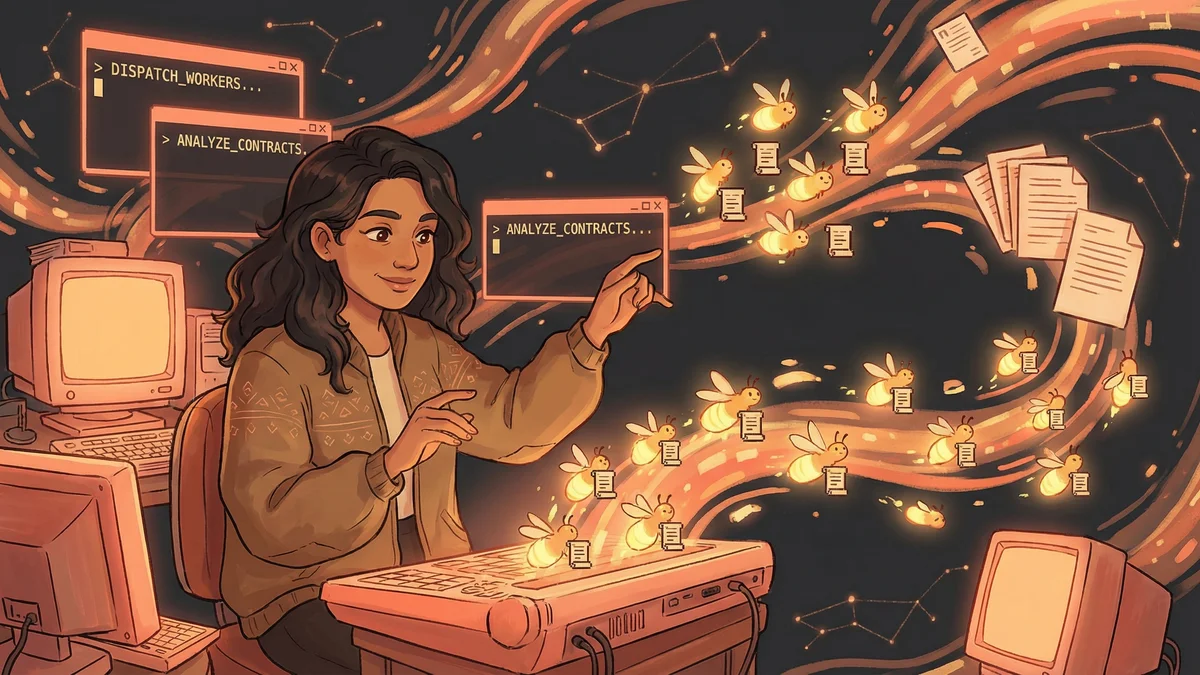
3,247 contracts couldn’t fit in one context window. Nadia designed a parallel processing system.
The Dispatcher: A script assigned contracts to processing queues based on type: customer, vendor, employment, partnership.
The Workers: Claude Code instances processed contracts in parallel. Each worker received:
- The playbook (what to flag)
- One contract (what to review)
- Output template (where to report)
No cross-contamination between contracts. No accumulated context. Fresh analysis for each document.
The Aggregator: Completed reviews fed into a master database. Flagged issues aggregated. Patterns emerged.
The Synthesizer: After all reviews completed, a final Claude session analyzed the aggregate data: what systemic risks exist across the portfolio?
Day One: The Pilot
Nadia started with 50 contracts as a test batch.
She fed 10 customer agreements to Claude with the prompt: “Review this agreement against the attached playbook. Flag any provisions that deviate from standard. Rate each clause as Standard, Favorable, Concerning, or Critical.”
Claude produced structured reports: clause by clause analysis, deviation flags, risk ratings.
“The first batch took 2 hours including my review. That’s 12 minutes per contract versus 60 minutes manually.”
The output quality was good enough. Not associate-level nuance, but solid first-pass identification of issues.
The Full Deployment
Nadia scaled to all 3,247 contracts.
Processing ran continuously for 72 hours. 8-10 parallel workers churning through documents. Each contract reviewed, analyzed, and flagged.
Daily progress:
- Day 1: 800 contracts processed
- Day 2: 1,100 contracts processed
- Day 3: 1,347 contracts processed
“We completed first-pass review in three days. Manually, it would have taken twenty.”
The Triage System
Not all flags were equal.
Claude categorized findings:
- Critical: Immediate deal-blocker issues (11 contracts)
- Concerning: Negotiation leverage or risk factors (147 contracts)
- Notable: Deviation from standard but manageable (892 contracts)
- Standard: No issues (2,197 contracts)
“67% of contracts were clean. We knew immediately where to focus attention.”
The 11 critical findings went to senior partners. The 147 concerning contracts got associate deep-dives. The rest got documented but didn’t need detailed review.
The Pattern Discovery
The aggregator found patterns humans might have missed.
“Claude flagged that 23 customer contracts contained non-standard termination clauses. When we looked deeper, they were all signed in the same quarter — apparently during a sales push where the team offered lenient terms.”
Another pattern: vendor contracts with Company X had unusually high liability caps. Investigation revealed a previous dispute that resulted in negotiated protection.
“These patterns would have taken weeks to surface through manual review. The aggregate analysis surfaced them in hours.”
The Associate Review
Human attorneys reviewed every flagged contract.
Not to verify Claude’s reading — the extraction was accurate. To apply judgment. To understand context. To assess business implications.
“Claude could tell me a clause was non-standard. It couldn’t tell me if the customer relationship was valuable enough to accept the deviation.”
The associates worked differently than before. Instead of reading every word of every contract, they read Claude’s analysis first, then dove into specific clauses.
“We went from reading contracts to reviewing analyses. Fundamentally different cognitive work.”
The Risk Report
Week two produced the deliverable: a comprehensive risk assessment.
Organized by category:
- Customer contract risks: 147 agreements with concerning terms
- Vendor concentration: 34% of procurement through 3 vendors with weak termination rights
- Employment exposure: 12 employment contracts with above-market severance provisions
- IP concerns: 7 contracts with ambiguous assignment language
“The report was 80 pages of synthesized analysis. Built from 3,247 individual reviews. Delivered on day 14.”
The Cost Comparison
Traditional approach:
- 4 associates × 200 hours × $300/hour = $240,000 in associate time
- Plus partner review, synthesis, report writing
AI-assisted approach:
- Claude API: ~$1,200 for all processing
- 4 associates × 80 hours × $300/hour = $96,000 in associate time
- Same partner involvement
Savings: $140,000 on this single due diligence project.
“The math convinced our managing partner before the project finished. He wanted this capability for every deal.”
The Limitations
Not every contract type worked equally well.
“Highly bespoke agreements — custom partnership deals, complex IP licenses — needed human first-pass. Claude could extract terms, but the non-standard structure meant playbook matching wasn’t meaningful.”
About 5% of contracts required traditional manual review. The playbook approach assumed contracts followed recognizable patterns.
“We built a triage step: if Claude says ‘this doesn’t match my expectations,’ route to human immediately.”
The Ongoing Integration
After the acquisition closed, the contract swarm became standard operating procedure.
New engagements started with Claude processing. Associates received pre-analyzed documents. Partner time focused on strategy, not review.
“We repositioned the team. Associates do less grunt work, more analytical work. They like it better. They’re learning more.”
The Compliance Application
The pattern extended beyond M&A.
Contract renewal review: Quarterly, Claude reviews all contracts approaching renewal. Flags terms that should be renegotiated.
Regulatory compliance: When regulations change, Claude reviews the contract portfolio for newly-problematic terms.
Vendor management: Annual vendor contract assessment identifies unfavorable terms to address in renewals.
“We built a contract intelligence layer. The portfolio is constantly monitored, not just reviewed at transaction time.”
The Philosophy
Nadia reflected on what the project taught her firm:
“Legal review has two components: extraction and judgment. Extraction is mechanical — identify what the contract says. Judgment is human — determine what it means for our client.”
The swarm handled extraction. Humans provided judgment.
“We’re not replacing lawyers. We’re giving lawyers better tools. The same way calculators didn’t replace accountants — they just changed what accountants do.”
The Current State
Two years later, contract analysis is a core firm capability.
They’ve processed over 50,000 contracts across 30+ engagements. The playbook has evolved with learnings from each project. Associates train on analysis review, not document reading.
“We win deals because we’re faster. Clients know we’ll complete due diligence in half the time. That speed has value.”
The 3,247 contracts that started it all? The acquisition closed successfully. The risks were known. The negotiations were informed.
“We found every skeleton in every closet. In 14 days. With AI doing the searching and humans doing the judging.”