TL;DR
- Top law firms reduced contract analysis from 16 hours to 4 minutes using AI (100x productivity gain)
- 315% increase in legal AI adoption from 2023 to 2024 across AmLaw100 firms
- Harvey AI (built on GPT-4) deployed to 3,500 lawyers across 43 offices at A&O Shearman
- Best for: Law firms, compliance teams, and document-heavy professional services
- Key lesson: AI handles pattern matching at scale; humans maintain oversight for judgment calls and hallucination prevention
A Harvard Law School study found that top law firms using AI for contract analysis achieved 100x productivity gains, reducing 16-hour legal reviews to 3-4 minutes while maintaining accuracy through human oversight.
A Harvard Law School study measured something unprecedented.
Ten of America’s top law firms — the AmLaw100 elite — adopted AI for contract analysis. The productivity gain wasn’t incremental.
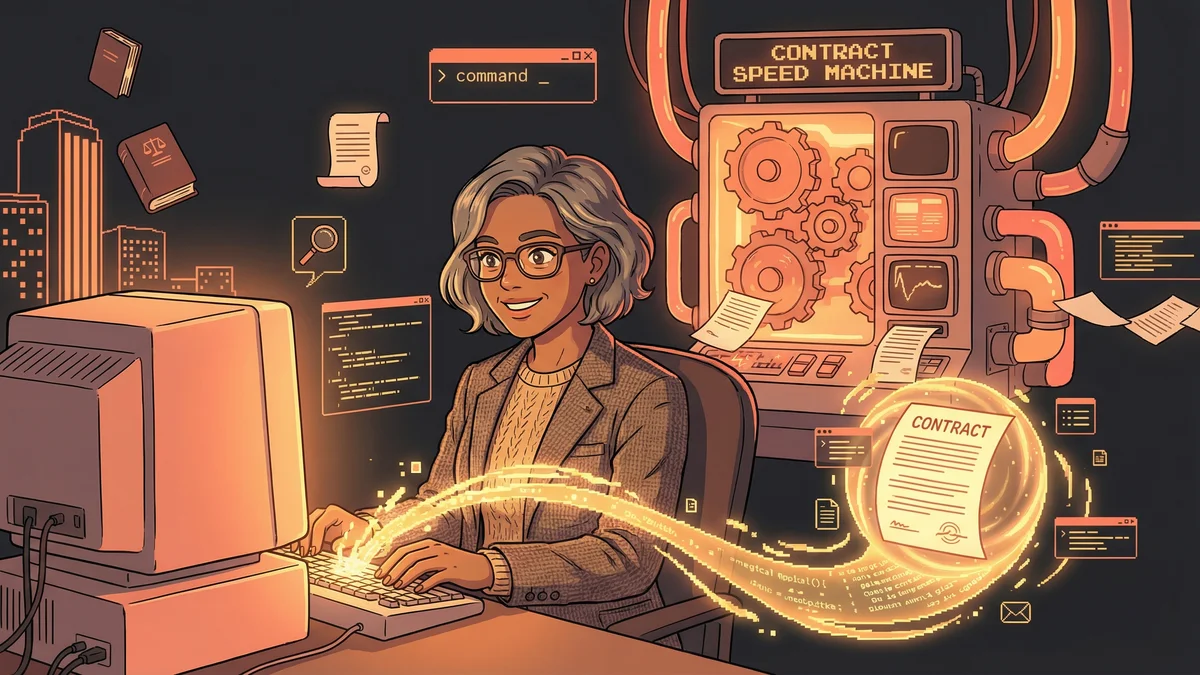
Sixteen hours to three or four minutes.
That’s not a typo. Tasks that took associates a full day completed in the time it takes to microwave lunch.
The Old Process
Legal contract review follows a pattern.
A lawsuit arrives. The complaint makes allegations. The law firm must respond.
Responding requires research. Which contracts apply? What do they say? Are there relevant clauses? Precedents? Exceptions?
Associates spend hours — sometimes days — reading documents. Taking notes. Building timelines. Flagging issues.
“It’s important work. It’s also mind-numbing. Read 500 pages of contracts. Find the three paragraphs that matter.”
The Scale Problem
Major litigation involves thousands of documents.
Discovery produces millions of pages. Merger due diligence examines every contract the target company ever signed. Regulatory investigations require comprehensive review.
“We’d staff teams of 10-15 associates on document review. They’d work 80-hour weeks for months. The bills were astronomical.”
Clients paid because they had no choice. The work had to be done. There was no other way.
The AI Alternative
AI changed “no other way” to “obviously obsolete.”
Modern legal AI reads contracts like humans do — understanding language, identifying relevant clauses, extracting key terms. But it reads thousands of pages in minutes.
“The AI doesn’t get tired. It doesn’t miss things because it’s 2 AM. It’s consistently thorough in ways humans can’t be.”
The Implementation
Major law firms partnered with legal AI providers like Harvey, built on OpenAI’s GPT-4.
Allen & Overy (now A&O Shearman) was among the first. They didn’t rush to production. They started with sandboxes.
“We put AI in a controlled environment. Let lawyers test it on real work. Build confidence before going live.”
The sandbox expanded. 3,500 lawyers across 43 offices eventually gained access.
“We processed 40,000 queries in the trial alone. Lawyers found it genuinely useful.”
The Complaint Response Transformation
The Harvard study focused on a specific task: responding to complaints.
Old process: Associate receives complaint. Reads it. Reviews all potentially relevant contracts. Identifies applicable clauses. Researches precedents. Drafts response framework. Sixteen hours minimum.
New process: Upload complaint to AI. Upload contract corpus. Ask: “What defenses are available based on these contracts?” Four minutes.
“The AI found relevant clauses we would have missed. It surfaced contracts we didn’t know existed. The analysis was more thorough, not less.”
The 100x Factor
Sixteen hours to four minutes is 240 times faster.
Conservative estimates call it 100x productivity improvement. That’s not marginal gains. That’s transformation.
“In my career, I’ve seen technology help lawyers work 10% faster. Maybe 20%. A hundred times faster changes what law practice is.”
The Billing Question
Law firms bill by the hour. Faster work means fewer billable hours.
“This is the awkward conversation. If AI does in minutes what associates did in hours, do clients pay the same?”
Firms responded differently. Some kept rates unchanged, arguing value wasn’t tied to time. Some built AI costs into rate structures. Some offered fixed fees for AI-augmented services.
“The honest answer: we’re still figuring it out. The business model built on billable hours is being disrupted.”
The Quality Check
Speed meant nothing without accuracy.
“Legal errors have consequences. Missing a clause in a contract review could mean losing a case. We had to verify AI output rigorously.”
Every AI-generated analysis gets human review. Lawyers verify citations. They check for hallucinations. They apply judgment the AI can’t.
“The AI generates a first draft. Humans make it right. That combination beats either alone.”
The Use Case Expansion
Contract analysis was the beginning.
Firms now use AI for:
- Due diligence in M&A transactions
- Regulatory compliance checking
- Case law research
- Document summarization
- Risk assessment
- Redlining and markup suggestions
“Once lawyers saw it work for contracts, they wanted it for everything. The demand exceeded our deployment capacity.”
The Associate Role Shift
The associate job changed fundamentally.
Old role: Read documents. Summarize findings. Bill hours.
New role: Direct AI analysis. Quality-check output. Apply judgment to edge cases.
“We’re not training associates to read faster. We’re training them to use AI effectively. Different skill entirely.”
Some associates resisted. Their competitive advantage was grinding through documents longer than competitors. AI eliminated that advantage.
“The associates who thrive now are the ones who embrace AI as a tool. The ones who resisted fell behind.”
The Failed Experiments
Not every AI application worked.
“We tried using AI for negotiation strategy. It was mediocre. The nuance of human negotiation isn’t something AI captures well.”
Some use cases required too much judgment. Some needed information AI couldn’t access. Some simply weren’t mature enough.
“The gap between expectations and reality was significant. AI does some things brilliantly. Other things, not at all.”
The Client Perspective
Clients noticed faster turnaround.
“Our law firm used to take two weeks for due diligence reports. Now it’s two days. Same thoroughness, better speed.”
Some clients specifically requested AI-augmented teams. They wanted the efficiency gains.
“Forward-thinking clients see AI as better service. They don’t want lawyers billing 80 hours when AI can do it in 8.”
The Competitive Pressure
AI adoption became a competitive necessity.
“When competitors deliver in days what you deliver in weeks, you lose clients. It’s that simple.”
Firms that moved slowly found themselves defending their processes. Why does this take so long? Why are we paying for inefficiency?
“The market is sorting itself. AI-first firms are winning the efficiency argument.”
The 315% Surge
Legal AI usage increased 315% from 2023 to 2024.
The growth reflected genuine adoption, not just experimentation. Lawyers used AI because it worked.
“Two years ago, AI in legal practice was theoretical. Now it’s essential.”
The Governance Framework
Top firms developed strict AI protocols.
“Every AI-generated document gets marked. Lawyers must review before sending to clients. Confidential information stays out of prompts.”
Governance ensured AI enhanced reputation rather than damaging it.
“An AI hallucination in a legal brief would be catastrophic. Our controls prevent that.”
The Human Judgment Core
AI handles pattern matching. Humans handle judgment.
“Should we sue? Should we settle? What’s the client’s risk tolerance? These questions require human understanding.”
The best implementations used AI for research and drafting, humans for strategy and decisions.
“AI is the fastest research assistant ever built. It’s not a lawyer.”
The Future Vision
Law firm leaders see this as early stage.
“We’re using AI for contract analysis. Eventually, AI will draft contracts from scratch. Review them. Negotiate them. We’re just getting started.”
The firms investing now build capabilities competitors will struggle to match.
“Legal AI is like the internet in 1998. Obviously important. Not yet mature. The gap between adopters and laggards will be permanent.”
The Pattern for Knowledge Work
Law firm AI adoption offers lessons for any knowledge-intensive field.
Start with high-volume, rule-based tasks. Contract analysis fits perfectly.
Maintain human oversight. AI drafts, humans verify.
Redesign workflows, not just tools. The 16-hour process wasn’t automated — it was replaced.
Expect business model tension. Efficiency gains challenge time-based billing.
“We didn’t make lawyers faster at the old job. We created a new job.”