TL;DR
- Claude Code built a complete civilization simulation from geology to politics in months of part-time work
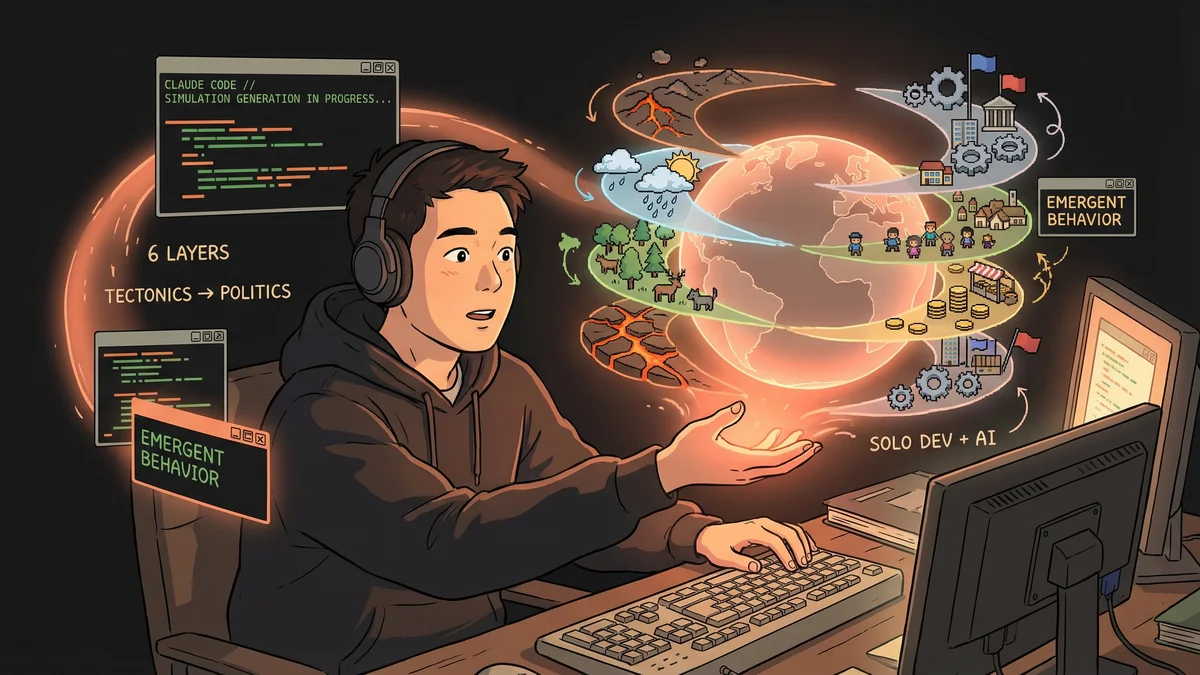
- Six interlocking layers: tectonics, climate, ecology, population, economy, politics
- Emergent behavior arises naturally from realistic underlying systems
- Best for: ambitious game projects, procedural generation, complex system simulation
- Key lesson: AI enables solo developers to build games that previously required large teams
Claude Code built a complete civilization simulation with plate tectonics, weather systems, and family trees, demonstrating how AI enables ambitious game projects that would previously require large teams.
The scope was ambitious.
Not just a game. A civilization simulation. Plate tectonics that shaped continents. Weather systems that affected agriculture. Family trees that tracked lineages across generations.
The kind of project that would take a team years.
One developer decided to see if Claude could build it.
The Vision
Civilization simulators aren’t new.
But most cut corners. Fixed maps instead of generated worlds. Simplified economics. Abstract population dynamics.
“I wanted the deep simulation. The kind where emergent behavior arises from realistic underlying systems.”
The simulation would start with geology and build up to societies.
The Layer Stack
The project required multiple interlocking systems:
Layer 1 — Geology: Plate tectonics. Continental drift. Mountain formation. Ocean formation.
Layer 2 — Climate: Temperature gradients. Precipitation patterns. Weather systems. Seasonal changes.
Layer 3 — Ecology: Biome distribution. Resource availability. Flora and fauna.
Layer 4 — Population: Birth, death, migration. Family structures. Community formation.
Layer 5 — Economy: Resource extraction. Trade. Specialization. Markets.
Layer 6 — Politics: Leadership. Territory. Conflict. Cooperation.
Each layer depended on layers below. Each influenced layers above.
The Iterative Build
Claude built layer by layer.
Week 1: Plate tectonics. Defining plates. Simulating movement. Generating realistic continent shapes.
Week 2: Mountain and ocean formation. Where plates collide, mountains rise. Where they separate, oceans form.
Week 3: Climate systems. Temperature based on latitude and altitude. Precipitation based on ocean proximity and mountain rain shadows.
Week 4-5: Biomes and ecosystems. Forests where rain is abundant. Deserts in rain shadows. Tundra at high latitudes.
Week 6-8: Population dynamics. Individuals with lifespans. Family relationships. Community structures.
The Emergent Behavior
The magic happened when systems interacted.
“Civilizations naturally formed in river valleys. Because the simulation made those regions fertile. Not because I coded ‘put civilizations in river valleys.’”
Trade routes emerged along mountain passes. Because those were the only ways through. Conflicts arose at resource boundaries. Because resources were scarce.
The behavior emerged from the simulation. It wasn’t prescribed.
The Family Tree Challenge
Tracking individuals across generations was computationally intense.
“Every person has parents. Potentially dozens of descendants. Across hundreds of years, that’s millions of relationships.”
Claude implemented efficient data structures. Generational culling for distant ancestors. Family networks that preserved important lineages while managing memory.
The Weather Realism
Weather wasn’t static.
Claude built atmospheric simulation. Pressure systems. Wind patterns. Storm formation.
“A drought in one region would affect crop yields. Which affected population growth. Which affected political stability. The cascade was realistic.”
The weather wasn’t just decoration. It was a driver of historical events.
The Economic Simulation
Economies emerged from resource distribution.
Regions with iron developed metalworking. Coastal areas developed fishing. Trade connected regions with complementary resources.
“Claude implemented supply and demand. Price discovery. Comparative advantage. The economics textbook came alive in the simulation.”
The Political Dynamics
Politics arose from competing interests.
Leaders gained power through resource control, military strength, or popular support. Alliances formed against common threats. Betrayals happened when incentives shifted.
“The political simulation wasn’t scripted drama. It was game theory playing out across thousands of actors.”
The Code Volume
The complete simulation was substantial.
Tens of thousands of lines across multiple subsystems. Physics, climate, biology, sociology, economics, politics — each domain with its own codebase.
“I couldn’t have written this alone in a reasonable timeframe. Maybe not at all. The systems were too interlocking.”
The Testing Approach
Testing a civilization simulator was different from testing typical software.
“You can’t unit test emergent behavior. You watch the simulation run. See if it produces plausible outcomes.”
Plausibility testing: do civilizations form where they should? Do they rise and fall at reasonable rates? Do the patterns match historical precedent?
The Iteration Cycles
Not everything worked the first time.
Early simulations had runaway population growth. Claude adjusted mortality factors.
Climate patterns produced unrealistic deserts. Claude refined the precipitation model.
Economies collapsed into boom-bust cycles. Claude added stabilizing mechanisms.
“Each problem required diagnosis and fix. Claude handled most of them. I handled the ones that needed design decisions.”
The Visualization Layer
Watching the simulation required visualization.
Claude built map rendering. Time-lapse displays. Statistics dashboards. Family tree browsers.
“The visualization was almost a separate project. But without it, you couldn’t understand what the simulation was doing.”
The Performance Challenge
Simulating civilizations was computationally expensive.
“Each tick of the simulation updated millions of data points. Weather, populations, economies, politics — all moving together.”
Claude implemented optimization. Spatial partitioning for local effects. Caching for expensive calculations. Approximations where precision wasn’t critical.
The Design Decisions
Some choices required human judgment.
“How much realism is enough? Where do you simplify for playability? What timescales matter?”
Claude implemented options. The human chose which to use.
The Final Product
The simulation worked.
Generate a world from tectonic seeds. Watch continents form. See climates stabilize. Observe life spread. Watch civilizations emerge, flourish, decline.
“It felt like watching history unfold. Except the history was unique every time.”
The Educational Value
The project was educational on multiple levels.
“I learned plate tectonics by having Claude implement them. Learned atmospheric science. Learned population dynamics.”
Building the simulation taught the domains it simulated.
The Replayability
Every simulation was different.
Different plate configurations. Different continental shapes. Different climate patterns. Different civilization trajectories.
“No two playthroughs were alike. Because the underlying simulation was genuinely generative.”
The Limitations
The simulation had boundaries.
Culture was simplified. Art and religion were abstractions. Individual psychology was minimal.
“You can’t simulate everything. We chose depth in physical and economic systems. Social systems were shallower.”
The Time Investment
Total development time: several months of part-time work.
Most of that time: Claude implementing. Human time: designing, reviewing, adjusting.
“Without AI, this project would have taken years. Maybe would have been abandoned as too ambitious.”
The Genre Implications
The civilization builder suggested something about game development.
“Complex simulations that would have required large teams can now be built by small teams with AI assistance.”
The scope ceiling had risen. What was impossible was now possible.
The Open Question
Could players tell the difference?
“Between a hand-crafted game and an AI-generated one? I think they’d notice the simulation depth. The emergent behavior. The systems that actually work.”
The provenance mattered less than the experience.