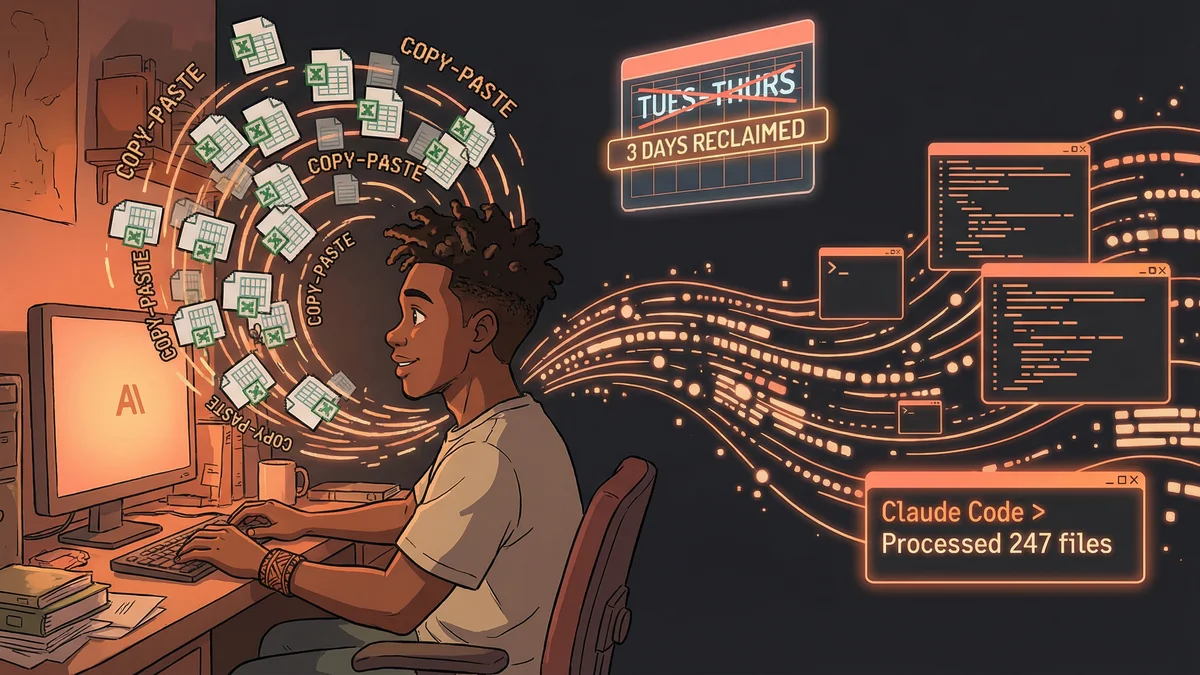
TL;DR
- Two OpenClaw users, two very different workflows, same insight: automate the boring stuff first
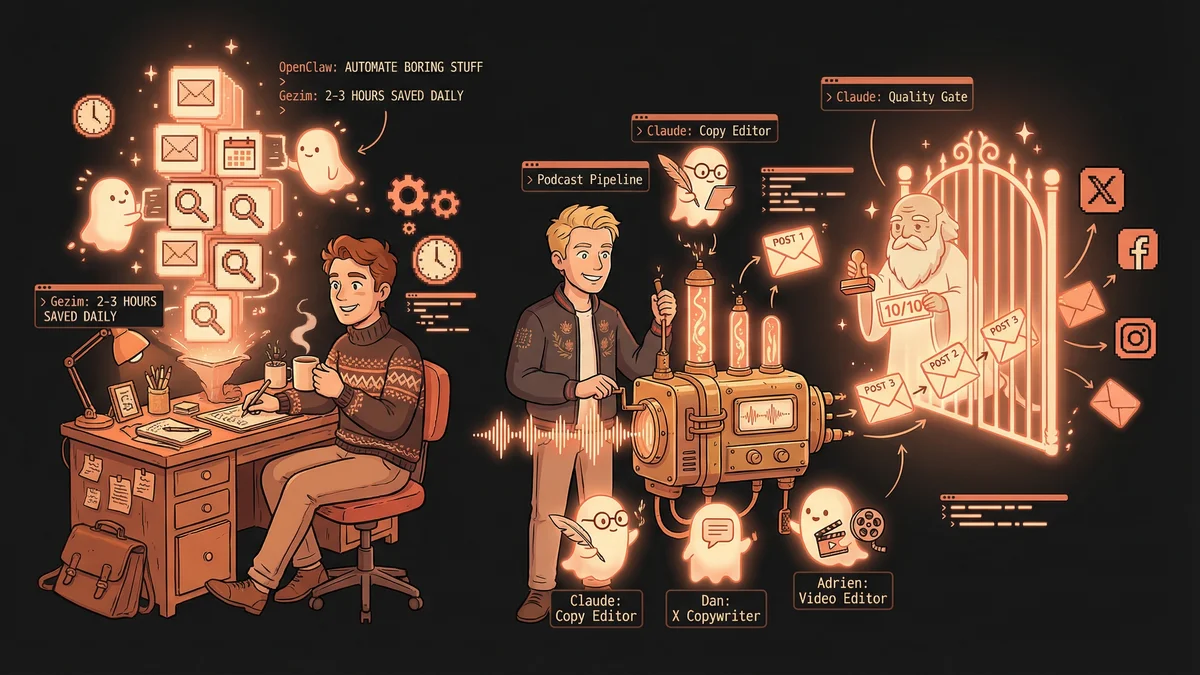
- Gezim saves 2-3 hours daily on email triage, calendar, research, and Twitter monitoring — “the repetitive tasks that don’t need your brain”
- Florian built a fully autonomous podcast-to-social pipeline: extract highlights, write posts, edit video, quality-check, schedule — 3 posts/day, zero manual work
- The 10/10 quality gate is what prevents AI slop from going public
- Neither system is flashy. Both are in production daily.
“The ‘whatever you want’ answer is lazy. Real use cases are the repetitive tasks you do daily that don’t need your brain.”
That’s Gezim, responding to someone asking what they’d actually do with an AI agent. And it cuts straight to the heart of why most AI demos miss the point.
The Boring Stack
When someone asks “what should I automate with AI?”, the honest answer isn’t “build a 37-agent startup.” It’s this:
- Check email. Flag what’s actually urgent.
- Manage the calendar.
- Run background research while you do other things.
- Monitor what people are saying in your space.
That’s Gezim’s daily OpenClaw setup. No agent swarms. No autonomous coding. Just the boring stuff that eats 2-3 hours every day through context switching alone.
“None of that is flashy but it saves me like 2-3 hours a day of context switching.”
The math is simple: 2.5 hours × 250 working days = 625 hours per year. That’s 78 eight-hour days you get back. For setting up email triage and calendar management.
The Podcast Pipeline
Florian went deeper. He built a multi-agent content pipeline that converts podcast episodes into social media posts — completely autonomously.
Here’s how it works:
Claude (Copy Editor) listens to podcast transcripts and pulls out the best moments. Not random quotes — the parts that actually make good standalone content.
Dan (X Copywriter) takes those moments and writes Twitter posts. Named agent, specific role, defined output format.
Adrien (Video Editor) handles the visual side — clipping video, removing dead air, adding subtitles. The boring production work that takes hours when done manually.
Claude (Quality Gate) reviews everything before it goes live. Rates the output. Only publishes if it scores 10/10.
“OK WE DID IT. Now my agents are 100% autonomous.”
The result: 3 posts per day. Zero manual work. Confirmed in production by his collaborator.
Why the Quality Gate Changes Everything
Here’s the part most people skip when building automation: without a quality checkpoint, you’re just publishing AI slop faster.
Florian’s system has a hard rule: Claude reviews every piece of content and rates it. If it’s not 10/10, it goes back for correction. Not 9/10. Not “good enough.” Perfect or redo.
“The 10/10 quality gate is the key part. No post goes out unless Claude says it’s ready.”
This is the difference between “I automated my content” and “I automated my content and now my audience thinks I’m a bot.” The gate matters more than the automation.
The Anti-Pattern
Compare this to what most people actually build:
- Get excited about AI agents
- Build something complex and impressive
- Show it off on Twitter
- Never use it again
Gezim and Florian built the opposite: unglamorous systems they use every single day. No demos. No viral threads about the architecture. Just email getting triaged and podcasts getting clipped.
The signal is in the boring.
The OpenClaw Pattern
Both systems run on OpenClaw, and the pattern is worth noting:
Gezim’s approach: Single agent, multiple daily tasks. The agent checks email, manages calendar, monitors Twitter, runs research — all as part of a daily routine. Think of it as an executive assistant that runs 24/7.
Florian’s approach: Multi-agent pipeline with clear handoffs. Each agent has one job. The copy editor doesn’t write tweets. The video editor doesn’t do quality review. Specialization plus quality gates.
Different architectures, same platform, same insight: the value isn’t in the technology. It’s in choosing the right boring problem to solve.
What This Means for You
If you’re looking at AI agents and thinking “what should I build?”, start here:
Step 1: List every task you do daily that doesn’t require creative thinking. Email, scheduling, reporting, monitoring, data entry.
Step 2: Pick the one that wastes the most time through context switching — not the one that takes the longest in absolute terms, but the one that interrupts you most.
Step 3: Automate it with a quality gate. Not “set it and forget it.” Set it, check it, gate it, then forget it.
The 2-3 hours you get back aren’t just time. They’re attention. And attention is what you actually need for the work that matters.
-> Sources: @HappyGezim | @floriandarroman