TL;DR
- One entrepreneur built a blog that publishes daily content with zero human writing—just $15-20/month in total costs
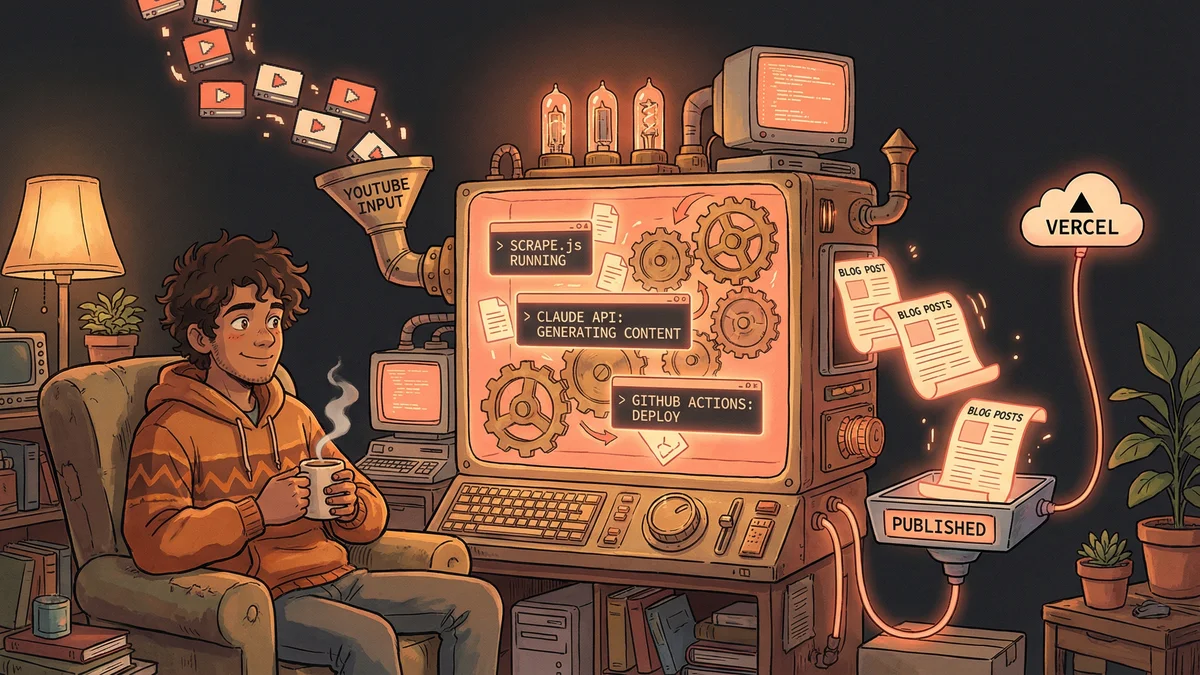
- Pipeline: YouTube transcripts scraped via Apify, transformed into original articles by Claude API, auto-published via GitHub Actions
- The entire system was built in one conversation with Claude Code: three scripts plus deployment
- Best for: Content marketers wanting to scale long-tail SEO with practical how-to content
- Key lesson: AI content isn’t inherently bad—the quality depends on prompt engineering and source material curation
Claude Code can build complete automated content pipelines that transform video transcripts into original blog posts, publishing daily without any human writing effort.
Kevin wanted a content website.
Not just any website — one that would grow without constant attention. Publish daily. Stay fresh. Require zero manual writing after initial setup.
“I’d seen content sites that needed armies of writers. I wanted to see if AI could be that army.”
He built HowDoIUseAI.com. It writes and publishes itself.
The Concept
The site covers practical AI applications. How to use AI tools. Real examples. Helpful guides.
The twist: AI writes all the content.
Not AI-assisted content where humans edit and refine. Fully automated content where humans never touch the articles.
“Every day at 6 AM, the pipeline runs. By 6:30, new articles are live. I don’t do anything.”
The Content Source
Original content is hard to automate. Reprocessed content is easier.
Kevin chose YouTube transcripts as source material. AI-related videos get transcribed, then Claude transforms those transcripts into original blog posts.
“The transcripts provide substance — real information from real creators. Claude transforms that into readable articles.”
The transformation wasn’t copying. Claude synthesized, reformatted, and wrote original prose based on the video content. Similar to how a journalist might write an article after watching a presentation.
The Architecture
Kevin described the whole system to Claude Code in one conversation.
“I said: build me a markdown-based blog on using AI. Categories, search, daily automated posting. Scrape YouTube for content, write posts from transcripts, publish automatically to GitHub, deploy to Vercel.”
Claude asked clarifying questions: Which YouTube channels? What hosting preferences? What categories?
Kevin answered. Then Claude built everything.
The Pipeline Scripts
Claude created three main scripts:
fetch-videos.ts: Uses Apify (a web scraping service) to download transcripts from specified YouTube channels. Runs daily to check for new videos.
generate-post.ts: Takes transcripts and feeds them to Claude’s API with a carefully crafted prompt. The prompt instructs Claude to write original, SEO-optimized blog posts — not summaries, not copies, but new content inspired by the source.
pipeline.ts: Orchestrates everything. Calls the fetch script, loops through new transcripts, calls the generate script for each, saves the resulting markdown files.
“Three scripts and a GitHub Action. That’s the whole system.”
The Automation Layer
GitHub Actions provided free automation.
A scheduled workflow runs daily at 6 AM UTC. It triggers the pipeline script, which does the fetching and generating. New posts commit to the repository automatically.
Vercel watches the repository. When new commits appear, it rebuilds and deploys the site.
“From video upload to live blog post — fully automated. The video creator doesn’t know. I don’t do anything. It just happens.”
The Quality Control
Automated content could be garbage. Kevin built in quality measures.
Prompt engineering: The generation prompt evolved through iteration. Clear instructions about tone, length, originality. Emphasis on practical value, not fluff.
Duplicate prevention: A processed-videos.json file tracks which videos have already been converted. The pipeline skips duplicates.
Content filtering: Some videos produce better articles than others. Kevin added rules: minimum transcript length, topic relevance, quality signals.
“The first few runs produced some weak content. I refined the prompt until the output was consistently useful.”
The First Hiccup
The initial run failed.
Apify returned transcripts in an unexpected format — an array of caption objects instead of a single string. Claude’s code expected one format, got another.
“I showed Claude the error. It analyzed the response, understood the problem, and fixed the parsing logic. Second run: five posts generated successfully.”
Debugging with AI felt different. Less frustration, more conversation. “This broke, here’s the error” led to “here’s the fix” in minutes.
The Skill Level Feature
After the basic system worked, Kevin wanted more.
“I asked Claude to add skill-level tags. Beginner, intermediate, advanced. Filter by difficulty.”
Claude modified both ends: the frontend got a filter UI, the content generation prompt got instructions to categorize each post by difficulty.
“One request, changes across the whole system. The feature just appeared.”
The Economics
Kevin tracked costs.
Hosting: Free (Vercel’s free tier) Automation: Free (GitHub Actions’ free tier) Scraping: Minimal (Apify’s per-use pricing) Content generation: $10-20/month in API usage
Total monthly cost: roughly $15-20 for a site that publishes daily content.
“Compare that to hiring writers. Even cheap freelancers cost $50+ per article. The automated system produces 30 articles monthly for $20.”
The economics were wildly favorable for automated content.
The Content Quality Question
Automated content has a reputation problem. Much of it is spam.
Kevin addressed this head-on.
“The content isn’t literary. It’s practical. Step-by-step, how-to, straightforward. For that format, AI writes better than average freelancers.”
The posts weren’t award-winning prose. They were useful guides that answered questions clearly. Good enough for readers searching for practical help.
The Traffic Pattern
The site launched with six posts. Within weeks, search traffic appeared.
Long-tail queries. People searching specific AI how-to questions. The content answered those questions.
“I’m not competing for ‘best AI tools’ — that’s too competitive. I’m answering specific questions like ‘how to use Claude for meeting notes.’ Less traffic per query, but thousands of queries.”
The content strategy worked because automation enabled breadth. Hundreds of specific articles instead of a few comprehensive ones.
The Ethical Considerations
Kevin thought about the ethics.
“I’m not plagiarizing — the content is original prose, just inspired by transcripts. I’m not deceiving readers — the site doesn’t claim human authorship.”
The disclosure question was real. Should automated content be labeled? Kevin added a footer mentioning AI generation. Transparency without apology.
“AI-generated content isn’t inherently bad. Bad content is bad. Good content is good. The generation method is just a tool.”
The Scaling Vision
The pattern was infinitely scalable.
More YouTube channels meant more content sources. More categories meant more topics. More sites could run on the same infrastructure.
“Theoretically, I could run a hundred sites this way. Each pulling from different content sources, each publishing daily. The marginal cost per site is almost nothing.”
The limit wasn’t technical — it was attention. Finding good niches. Maintaining quality. Managing the portfolio.
The Competitive Dynamic
Others could copy the approach.
“The barrier isn’t the code — Claude could build this for anyone. The barrier is execution: choosing good sources, refining prompts, building traffic over time.”
First-mover advantage mattered less than operational excellence. The system was reproducible. Success required discipline, not secrets.
The Philosophical Shift
Building a self-writing blog changed Kevin’s perspective on content.
“I used to think content required human effort. Now I think content requires human judgment — but not necessarily human execution.”
The judgment: what topics to cover, what quality bar to set, what audience to serve. The execution: automated.
“Writers become editors. Editors become curators. The human role climbs the ladder of abstraction.”
The Current State
Months later, the blog continued running.
Daily posts. Growing archive. Steady traffic. Zero human writing time.
“I check it weekly to make sure nothing’s broken. That’s it. The rest runs itself.”
The proof of concept had become a sustainable system. Content without content creation. Publishing without publishers.
“It’s not the future of all content. But it’s definitely the future of some content. And that future is already here.”