TL;DR
- BBVA deployed AI to 120,000 employees in 7 months, achieving 80% daily active usage
- Employees created 700+ production custom GPTs from 3,000 experiments
- Saves 3 hours per week per employee (18.7 million hours annually)
- Best for: Large enterprises seeking company-wide AI transformation over limited pilots
- Key lesson: Go wide, not deep; eliminate shadow AI by making sanctioned tools better
BBVA deployed ChatGPT Enterprise to all 120,000 employees in seven months, with employees building 700 production-grade custom GPTs that save an average of 3 hours per week per person.
BBVA had a theory about AI adoption.
The Spanish banking giant believed that broad deployment would beat limited experimentation. Instead of giving AI to a few teams, they’d give it to everyone.
“We started with 3,300 licenses in May. By December, all 120,000 employees had access.”
Seven months. From pilot to universal deployment. The scale was unprecedented.
The Starting Point
BBVA began like most enterprises: cautious experimentation.
A small team tested ChatGPT Enterprise. Legal reviewed it. Compliance approved it. IT secured it.
“The pilot was fine. Good results. Limited impact. The usual story.”
Then leadership made an unusual decision. Instead of slow expansion, they went company-wide.
“If AI is valuable for 3,000 people, it’s valuable for 120,000. Let’s just do this.”
The Deployment Sprint
Rolling out AI to 120,000 employees in seven months required infrastructure.
Training: Every employee received AI literacy education. Not optional. Required.
Leadership first: 250+ executives, including the CEO, went through training. Leaders used the tools visibly.
Governance: Legal, compliance, and IT collaboration defined acceptable uses.
Support: Help desks handled AI questions. Documentation covered common scenarios.
“We didn’t just flip a switch. We built the organizational capability to use AI effectively.”
The Custom GPT Explosion
Something unexpected happened: employees started building.
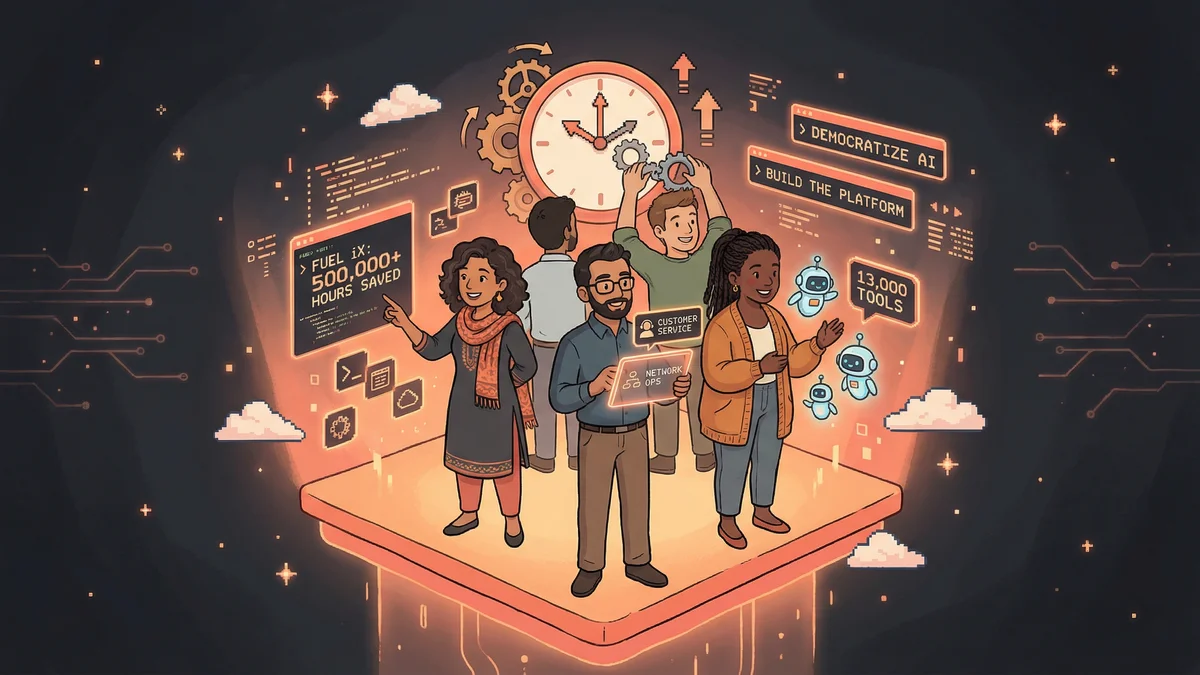
ChatGPT Enterprise allows custom GPTs — specialized assistants trained for specific tasks. BBVA employees created over 3,000 custom GPTs.
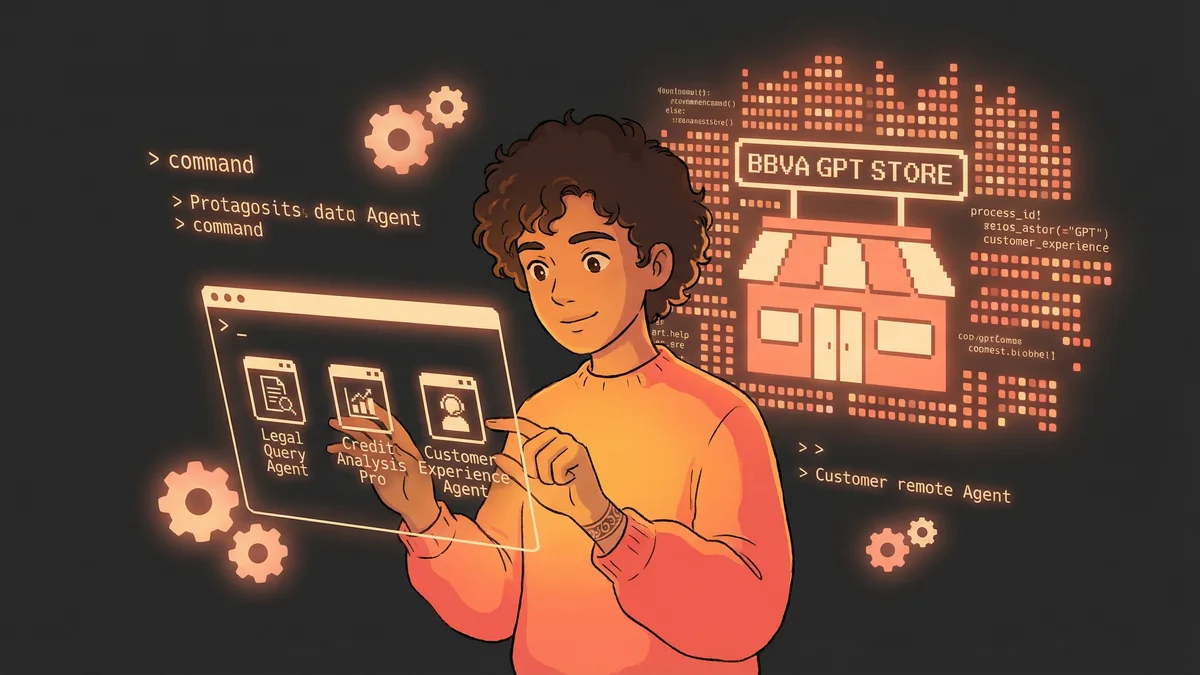
From those 3,000, about 700 proved valuable enough for broad use. They now populate BBVA’s internal “GPT Store.”
“We didn’t know what our people would build. They built things we never would have imagined.”
The Legal Query Agent
The Legal department’s custom GPT handles 40,000+ queries annually.
Employees used to email lawyers with questions. Wait times stretched to days. Simple questions consumed expensive legal time.
“People didn’t know if something required legal review. They’d ask just in case. Our inbox was overwhelmed.”
Now employees ask the Legal GPT first. It answers routine questions instantly. Only complex issues escalate to humans.
“The GPT delivers 26% of our annual savings target. One tool. Twenty-six percent of our efficiency goal.”
The Credit Analysis Pro
Risk assessment used to require manual data gathering.
Analysts would pull company financials, news, market data. They’d synthesize it into risk profiles. Hours per company.
The Credit Analysis Pro GPT automates extraction. Feed it a company name, get back a structured risk assessment with data from multiple sources.
“What took an afternoon takes minutes. And the output is more consistent than what humans produced.”
The Customer Experience Agent
Customer satisfaction surveys generate thousands of responses. Someone has to read them.
The Customer Experience GPT processes surveys automatically. It categorizes feedback, identifies themes, flags urgent issues.
“We used to sample surveys. Read maybe 10%. Now we analyze 100% in real time.”
Patterns emerge faster. Problems get noticed before they spread.
The Adoption Metrics
The numbers showed genuine adoption, not just availability.
80% daily active usage among employees with access.
83% weekly engagement — people came back repeatedly.
3 hours per week saved on average per employee.
“These aren’t vanity metrics. Eighty percent daily usage means people find it genuinely useful.”
The Shadow AI Elimination
Before the official deployment, employees used AI anyway.
Personal ChatGPT accounts. Unauthorized tools. Data flowing to who-knows-where.
“Shadow AI was everywhere. People needed the capability. They found workarounds.”
The enterprise deployment eliminated the shadow problem. Sanctioned tools meant secure tools. The unofficial channels closed.
“We didn’t stop AI usage. We made it safe. People got what they needed without the risk.”
The Cultural Shift
AI became part of how work happened.
“New hires now expect AI assistance. It’s like expecting email or spreadsheets. Just part of the job.”
Managers incorporated AI into workflows. Meetings included AI-generated summaries. Reports started with AI-drafted analysis.
“The culture shifted from ‘should we use AI?’ to ‘why didn’t you use AI?’”
The Governance Framework
Broad deployment required clear rules.
What’s allowed: Using AI for drafting, analysis, summarization, ideation.
What’s prohibited: Sharing customer personal data with AI. Making final decisions without human review.
What requires approval: New custom GPTs for production use. External-facing AI applications.
“Freedom within boundaries. People could experiment, but within a framework that protected the bank.”
The framework evolved as edge cases emerged. Weekly reviews addressed new questions.
The Training Investment
Not everyone adapted naturally.
Some employees feared AI. Some didn’t understand it. Some assumed it would replace them.
“We invested heavily in training. Not just ‘how to use the tool’ but ‘how AI changes your role.’”
Training emphasized augmentation over replacement. AI as teammate, not competitor.
“When people understood that AI made them more valuable, not less valuable, adoption accelerated.”
The 3-Hour Calculation
Three hours per week per employee. Do the math.
120,000 employees × 3 hours × 52 weeks = 18.7 million hours annually.
At average loaded labor cost, that’s hundreds of millions in productivity value.
“Even if our estimate is optimistic, even if it’s only two hours per week, the numbers are transformative.”
The Executive Buy-In
CEO involvement wasn’t ceremonial.
“Our CEO went through the training. He uses the tools. He mentions AI in all-hands meetings. That signals priority.”
When executives visibly use technology, employees pay attention. When executives ignore it, employees do too.
“Leadership behavior is the most powerful training program. Show, don’t tell.”
The Iteration Cycle
The deployment wasn’t a one-time event.
Monthly reviews assess what’s working. Quarterly updates add new capabilities. Annual planning sets AI strategy.
“We’re not done. We’re continuously improving. The 700 GPTs today will be 1,000 next year.”
User feedback drives development. Popular GPTs get enhanced. Unused ones get retired.
The Competitive Context
Other banks watched BBVA’s approach.
“We’re not the only bank using AI. We might be the fastest to deploy universally.”
First-mover advantage accrued. BBVA employees developed AI fluency while competitors deliberated.
“By the time other banks catch up, our people will be two years more experienced. That gap matters.”
The Pattern for Enterprise
BBVA’s approach offers lessons for large organizations.
Go wide, not just deep. Broad deployment creates organizational capability.
Let employees build. Custom GPTs from actual users solve real problems.
Train leaders first. Executive adoption drives cultural change.
Eliminate shadow AI. Sanctioned tools are safer than workarounds.
Measure everything. Know whether the investment generates return.
“We treated AI as infrastructure, not experiment. That mindset made the difference.”