TL;DR
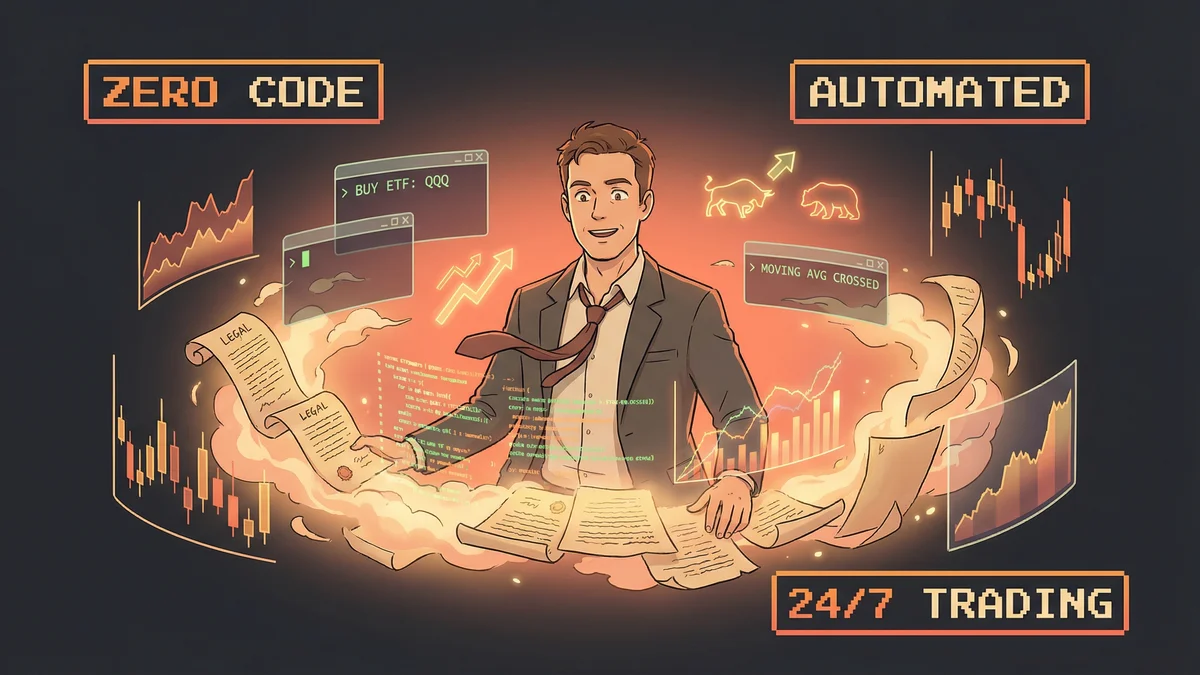
- A lawyer with zero coding experience built a fully automated cloud trading system in one month
- The system runs 24/7, executing ETF trades based on moving average strategies without human intervention
- Built incrementally: price fetcher, moving average calculator, broker integration, cloud deployment
- Best for: Domain experts who have clear strategies they want to automate but lack programming skills
- Key insight: AI replaced the coding learning curve with a learning curve everyone starts together
Claude Code enables non-programmers to build sophisticated automated trading systems by translating domain expertise into working code—no Python tutorials required.
Marcus had always wanted to build something.
He was a lawyer. Good at contracts, negotiations, understanding complex systems. But the software world felt locked behind a gate he couldn’t open.
“I’d tried learning to code three times. Python tutorials. JavaScript courses. Each time I’d get a few weeks in, hit a wall, and abandon it. The learning curve was just too steep for someone with a full-time job.”
Then he heard about Claude Code.
The Trading Idea
Marcus had been manually executing a simple trading strategy for years. Buy certain ETFs when they dropped below their moving average. Sell when they rose above it. Nothing fancy — just disciplined execution.
“The strategy worked. But I was the bottleneck. I had to check prices every day. Sometimes I’d miss opportunities because I was in court. Sometimes I’d forget to check for a week.”
He wanted automation. Every tutorial he found assumed coding knowledge he didn’t have.
“I mentioned this to a friend who worked in tech. He said, ‘Have you tried Claude Code? It can build things for you.’”
The First Conversation
Marcus installed Claude Code on a Saturday morning. He wasn’t sure what to expect.
He typed his first message: “I want to build an automated trading system that monitors ETF prices and executes trades based on moving average crossovers. I have zero coding experience. Is this possible?”
Claude’s response surprised him.
“It didn’t say ‘here’s a Python tutorial.’ It asked me questions. What broker did I use? What ETFs? What were my exact buy and sell rules? How much capital per trade?”
The AI was gathering requirements like a developer would. But in plain English.
The Architecture Session
Over the next hour, Claude helped Marcus design a system.
“It explained that we’d need several pieces: something to fetch price data, something to calculate moving averages, something to execute trades through my broker’s API, and something to run this automatically every day.”
Claude drew out the architecture in words. Each component, what it would do, how they’d connect.
“I understood the system before any code existed. That was different from tutorials where you type things and hope they work.”
Then Claude started building.
The Incremental Development
Claude didn’t dump thousands of lines of code and say “good luck.”
It built piece by piece, explaining each part.
“First we built the price fetcher. Claude wrote a Python script, then showed me how to run it. I saw real ETF prices appear in my terminal. That felt like magic.”
Next, the moving average calculator. Then the trading logic. Each piece tested before moving on.
“I was learning without formally learning. Each component taught me something about how software works. Not enough to write it myself, but enough to understand what was happening.”
The Broker Integration
Connecting to a real brokerage was the scary part.
“This wasn’t play money. Claude was going to write code that could buy and sell real assets in my real account.”
Claude walked Marcus through the broker’s API documentation. Set up authentication. Implemented safety limits.
“Claude insisted on safeguards I wouldn’t have thought of. Maximum trade size. Daily loss limits. A kill switch if something went wrong. It was more cautious than I was.”
They tested with paper trading first. Simulated transactions that didn’t use real money.
“For two weeks, I watched the system make fake trades. It did exactly what I would have done manually, just faster and more consistently.”
The Cloud Deployment
A script on Marcus’s laptop wasn’t good enough. It needed to run 24/7.
“Claude explained cloud hosting. AWS, Google Cloud, the options. It felt overwhelming — another technical mountain.”
But Claude handled it step by step.
“We set up a small server in the cloud. Claude wrote the deployment scripts. Showed me how to check if the system was running. How to read the logs.”
The whole cloud setup took an afternoon. Marcus had expected weeks.
“I have a server running in the cloud. Me. A lawyer who failed Python 101 three times.”
The First Real Trade
The system went live on a Monday.
Marcus watched nervously. Around 2pm, an ETF dropped below its moving average. The system detected it. Calculated the position size. Executed the buy.
“I got an email notification. ‘Trade executed: BUY 47 shares of VTI at $213.42.’ The system had done what I’d designed it to do. Without me touching anything.”
Over the following weeks, the system continued executing. Not every trade was a winner — that’s not how trading works — but the system was consistent.
“It removed emotion. It removed forgetfulness. It just executed the strategy, every single day.”
The Iteration Cycle
The first version wasn’t perfect. Marcus wanted changes.
“I noticed the system was trading during high-volatility moments when I would have waited. I told Claude, ‘Can we add a rule to skip trades when volatility is above a certain threshold?’”
Claude added the feature. Explained the implementation. Deployed the update.
“This iterative improvement — describe what you want, Claude builds it — felt like having a developer on staff. Except I could afford it.”
The Learning Curve Shift
Marcus realized something profound about his experience.
“AI replaced the coding learning curve with a different learning curve: learning to work with AI. But this new curve is one everyone starts together. No advantage for people with CS degrees.”
He’d gone from “I can’t build software” to “I built a cloud trading system” in about a month.
“The system isn’t sophisticated by Wall Street standards. But it works. It does what I need. And I made it.”
The Boundaries Understood
Marcus was honest about limitations.
“I don’t fully understand every line of code Claude wrote. If something breaks in a weird way, I might need help debugging it.”
He’d built a system, not become a software engineer. The distinction mattered.
“But I also don’t understand every component in my car. I can still drive it. I know enough to maintain the trading system, add features, fix simple problems. That’s sufficient for my purposes.”
The Broader Realization
Marcus’s experience illustrated a shift happening across industries.
“Every domain has tasks that ‘require coding.’ Data analysis. Automation. Integration. Previously, non-technical people had to hire developers or use limited no-code tools.”
Claude Code represented a third option: describe what you want, iterate on the result, deploy something real.
“I’m not going to become a software developer. But I can now build the specific tools I need. That’s a meaningful change in what’s possible for people like me.”
The Advice
For others considering ambitious projects without technical backgrounds:
“Start with something you actually need. Not a tutorial project — a real problem you want solved. The motivation carries you through the frustrating parts.”
Expect iteration. The first version won’t be perfect. Neither will the second.
“Claude doesn’t judge that you don’t know what an API is. It just explains and builds. Use that patience. Ask every dumb question. There are no penalties for not knowing things.”
The Current State
A year later, Marcus’s trading system still runs daily.
He’s added features — additional ETFs, more sophisticated entry rules, better reporting. Each enhancement was a conversation with Claude.
“I check it once a week. Mostly to confirm it’s still running. The system handles everything else.”
The lawyer who couldn’t finish a Python tutorial now operates automated trading infrastructure.
“I’m still not a programmer. I’m a lawyer who uses AI to build things. That’s a new category of person. And there’s room for a lot more of us.”