TL;DR
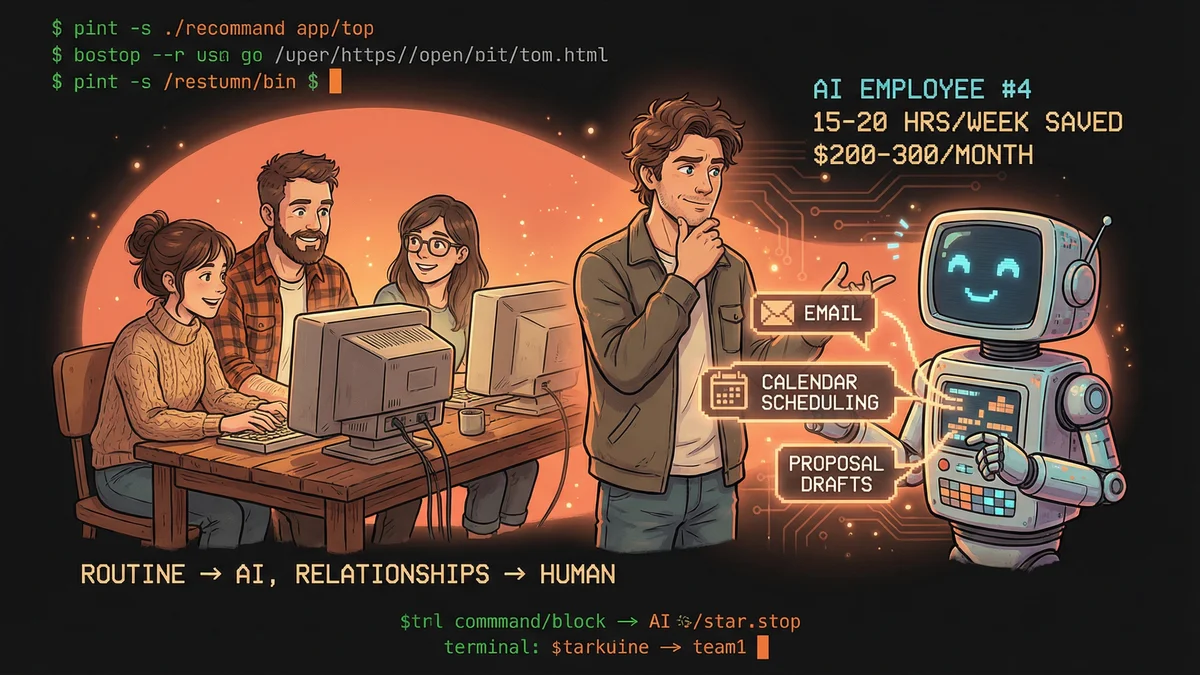
- Small agency hired AI instead of fourth employee for admin tasks
- Time recovered: 15-20 hours/week across the team
- Cost: $200-300/month in AI services vs part-time salary
- Best for: email triage, scheduling, proposal drafts, meeting notes
- Rule: AI handles routine work, humans handle relationships and judgment
What if instead of hiring another employee, you hired algorithms? Derek had a hypothesis.
What if instead of hiring another person, he hired AI?
His marketing agency had three employees. Growth meant more work than three people could handle. The traditional answer: hire a fourth.
But hiring is expensive. Salary, benefits, training, management overhead. And if the growth slowed, he’d have to lay someone off.
“I started calculating what I actually needed. Someone to handle scheduling. Someone to answer routine questions. Someone to draft first versions of proposals. Those aren’t creative jobs. They’re systematic jobs.”
What if AI could do them?
The Job Description
Derek wrote a job description — for an AI.
Responsibilities:
- Answer routine client questions via email
- Schedule meetings across multiple calendars
- Generate first drafts of proposals based on templates
- Summarize meeting notes and create action items
- Monitor project deadlines and send reminders
These tasks consumed roughly 15-20 hours per week across his team. If AI handled them, those hours could go to billable client work.
The Platform Search
Derek explored “AI employee” platforms.
Services like Lindy, Sintra, and others promised exactly what he wanted: AI agents that could be “hired” to perform specific roles. Not chatbots — actual autonomous workers.
He tested several.
Lindy: Could handle email triage, calendar management, and voice calls. You could configure multiple “Lindys” with different personalities and specialties.
Sintra: Offered pre-built “helpers” — an email assistant, a social media helper, a data analyst.
Bardeen: Worked inside his browser, automating sequences across web apps. It could scrape data, fill forms, and connect services that didn’t have native integrations.
Each had strengths and limitations. None were perfect. But together, they could cover most of the “job description.”
The Email Triage
The first win: email management.
Derek received 100+ emails per day. Many were routine — scheduling requests, follow-ups, status checks. Sorting through them consumed 1-2 hours daily.
He configured an AI to triage incoming email:
- Urgent matters: flagged and forwarded immediately
- Scheduling requests: handled automatically (checking calendars, proposing times)
- Status questions: drafted responses for Derek to review
- Spam/newsletters: archived or deleted
Result: Email time dropped from 1-2 hours to 20-30 minutes per day.
The AI wasn’t perfect. It occasionally flagged something as urgent when it wasn’t, or missed nuance in client requests. But even with review time, the net savings were substantial.
The Meeting Assistant
The second win: meetings.
Derek’s agency had many calls — client check-ins, strategy sessions, vendor meetings. Each meeting needed notes, action items, and follow-ups.
He added an AI note-taker that joined calls, transcribed conversation, and generated summaries.
After each meeting, Derek received:
- A transcript (searchable)
- A summary of key points
- A list of action items with suggested assignees
- Draft follow-up email to send to attendees
“I used to spend 15-20 minutes after each call writing up notes. Now I spend 2 minutes reviewing what the AI wrote.”
The action items were particularly valuable. No more forgetting what was promised. No more clients asking “Did you do that thing we discussed?” and having to pretend he remembered.
The Proposal Generator
The third win: proposals.
Derek’s agency wrote proposals constantly. Most followed similar structures — introduction, scope, pricing, timeline, terms.
He created proposal templates and connected them to an AI that could customize based on inputs.
For a new prospect, he’d fill out: client name, project type, key requirements, budget range, timeline.
The AI generated a complete proposal draft. Not final-ready, but 80% there.
Before AI: 2-3 hours per proposal After AI: 30-45 minutes per proposal (including review and customization)
He could respond to RFPs faster, increasing his win rate simply by being more responsive.
The Costs
The AI employee wasn’t free.
Monthly costs across platforms: approximately $200-300.
Plus time for setup and configuration. The first month involved significant trial and error — configuring rules, testing workflows, fixing mistakes.
And ongoing maintenance. When processes changed, the AI needed updating. When it made errors, Derek had to diagnose why.
“It’s not hire-and-forget. It’s more like having a very junior employee who follows rules exactly but can’t improvise.”
The Human Element
Some things AI couldn’t do.
Client relationships. When a client was frustrated, they needed a human voice. AI handling a complaint could escalate rather than resolve.
Creative strategy. The AI could generate proposals and summaries, but it couldn’t advise a client on their marketing direction or identify opportunities they hadn’t considered.
Team management. Derek’s employees needed human leadership — feedback, motivation, career development. AI handled tasks, not people.
“I learned pretty quickly where AI belongs and where it doesn’t. It’s incredible at routine. It’s terrible at judgment.”
The Staff Response
Derek worried his team would feel threatened.
He was transparent: “I’m adding AI to handle the administrative stuff. This isn’t about replacing anyone. It’s about getting more time for actual work.”
His employees were initially skeptical. Then they saw the email triage saving them time. And the meeting summaries showing up in their inboxes automatically. And proposals taking half as long.
“They went from suspicious to enthusiastic in about two weeks. Once they experienced not having to spend an hour on status emails, they were converts.”
The AI didn’t take anyone’s job. It took everyone’s least favorite tasks.
The Over-Automation Warning
Derek made mistakes.
He tried automating client communications too aggressively. An AI response went out that was technically correct but tonally wrong for a sensitive situation. The client was offended.
He automated meeting scheduling without enough constraints. The AI double-booked him multiple times before he fixed the configuration.
He trusted an AI summary that missed a critical detail from a call. He made a decision based on incomplete information and had to backtrack.
“Every failure taught me something. Usually: AI needs more guardrails than you think. And humans need to review more than you’d hope.”
He developed a hierarchy:
- Fully automated: Internal administrative tasks
- AI + human review: Client-facing communications
- Human only: Strategic decisions, relationship management
The Results
Six months after the AI employee experiment:
Time recovered: Approximately 15-20 hours per week across the team Money saved: Roughly equivalent to a part-time employee Capacity added: Team could handle 20% more client work Cost: $200-300/month in AI services plus setup time
The math worked. AI wasn’t cheaper than employees at everything, but it was dramatically more efficient at specific, well-defined tasks.
Derek didn’t replace his fourth hire with AI. He augmented his existing team so they could do what a four-person team would do without adding salary.
The Philosophy
Derek’s conclusion wasn’t “AI replaces people.” It was more nuanced.
“AI is really good at following rules consistently. Humans are really good at handling exceptions and building relationships. The best outcome is AI doing rule-based work so humans can focus on exception-handling and relationships.”
His agency still hired. They added a senior strategist whose entire role was high-judgment work — the kind AI couldn’t touch.
But they didn’t hire an admin. They didn’t hire a scheduler. They didn’t hire a note-taker.
“Those roles are now AI. And honestly? The AI does them more reliably than a human would, because it never has an off day and never forgets.”
The Ongoing Experiment
Derek continues evolving his AI stack.
New tools emerge constantly. Capabilities improve. What didn’t work last year might work now.
“I think of it as ongoing R&D. Every few months I try something new. Half of it doesn’t stick. But the half that does keeps making us more efficient.”
The experiment isn’t over. It’s ongoing. And for a small agency competing against larger firms, AI isn’t a luxury.
“It’s how we stay competitive. We’re three people running like six because three of them are algorithms.”