TL;DR
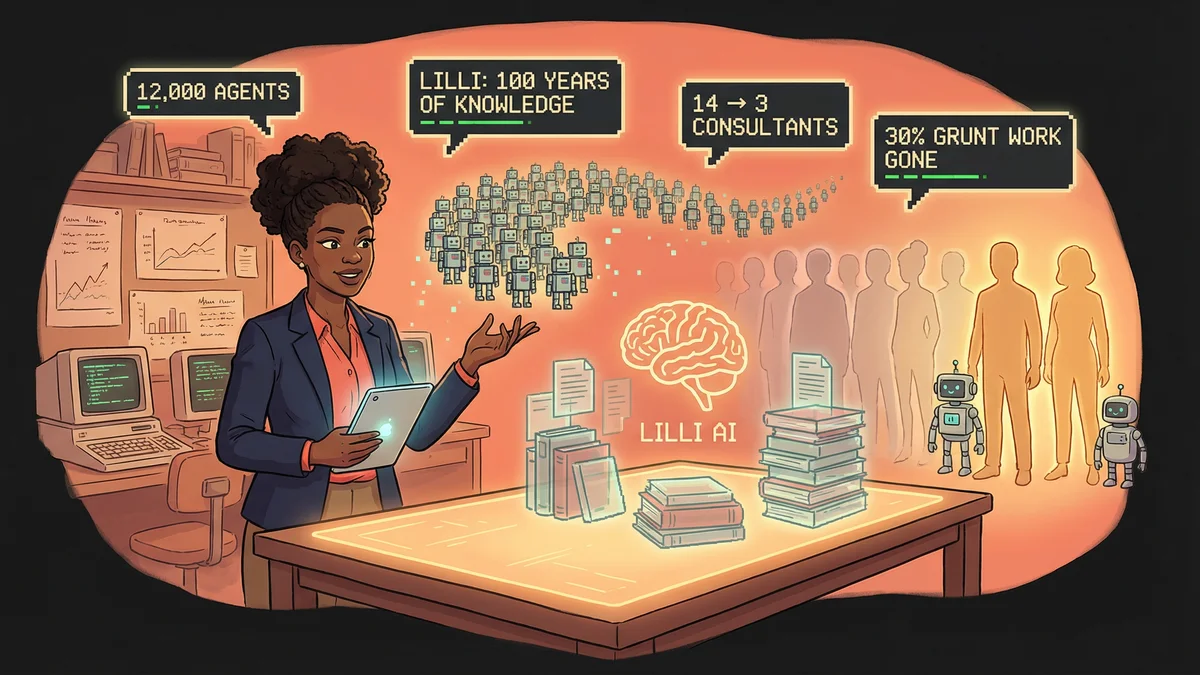
- McKinsey deployed 12,000 specialized AI agents across the firm, reducing team sizes from 14 to 3 consultants
- 30% reduction in time spent on “grunt work” like research, synthesis, and document formatting
- Lilli AI trained on 100,000+ documents spanning 100 years of firm knowledge
- Best for: Knowledge-intensive professional services firms seeking operational transformation
- Key lesson: Disrupt yourself before competitors do; internal AI capabilities become sellable products
McKinsey reduced consulting teams from 14 people to 3 people plus AI agents by deploying 12,000 specialized agents across the firm, achieving a 30% reduction in research and analysis grunt work while generating $6.4 billion annually from AI advisory services.
McKinsey has a business model problem. Or had.
The world’s most prestigious consulting firm charges hundreds of dollars per hour for smart people to research, analyze, and synthesize information. That model works until AI can do the same work faster.
“We saw the disruption coming. We could either be disrupted or disrupt ourselves.”
They chose to disrupt themselves. The result: approximately 12,000 AI agents deployed firm-wide.
The Old Model
Traditional consulting followed a pattern.
Big problems required big teams. A typical engagement might have 14 consultants: partners, managers, associates, analysts. Each person had a role in the research, analysis, and presentation.
“A lot of that work was information gathering. Reading reports. Synthesizing documents. Building frameworks. Smart people doing tasks that machines should do.”
The hours added up. Clients paid for all of them. The premium was justified by the synthesis — the human insight that connected disparate data points.
But much of what clients paid for wasn’t synthesis. It was grunt work.
The Transformation
McKinsey built “Lilli” — an internal AI trained on 100,000+ documents spanning over 100 years of the firm’s accumulated insights.
Every engagement the firm had ever done. Every framework developed. Every analysis produced. Lilli absorbed it all.
“Lilli knows what McKinsey knows. Everything we’ve learned about strategy, operations, organization design — it’s in there.”
Over 70% of McKinsey’s 40,000 staff now use Lilli regularly. It’s not a side tool. It’s central infrastructure.
The 12,000 Agents
The deployment expanded beyond a single AI. McKinsey now runs approximately 12,000 specialized agents across different domains.
Some agents specialize in market analysis. Others focus on organizational design. Others handle financial modeling. Still others manage competitive intelligence.
“We didn’t build one super-agent. We built an army of specialists. Each agent is excellent in its domain.”
The agents communicate. A strategy engagement might involve market analysts, financial modelers, and competitive intelligence specialists all working together — just AI versions instead of human versions.
The Team Compression
The most dramatic change: team size.
Engagements that once required 14 consultants now run with 2-3 people plus AI agents.
“The humans handle client relationships, strategic framing, and executive presentation. The agents handle research, analysis, and initial synthesis.”
This isn’t theoretical. Actual client engagements now operate this way.
“We had a project that would have traditionally required eight associates doing competitive research. Two associates with AI agents did it faster and more comprehensively.”
The Grunt Work Reduction
McKinsey quantified the impact: 30% reduction in time spent on “grunt work.”
Research that took days takes hours. Synthesis that took hours takes minutes. Documents that required manual compilation get auto-generated.
“Our associates used to spend most of their time building PowerPoint slides and formatting tables. Now they spend their time thinking about what the slides should say.”
The work product improved because humans could focus on insight rather than mechanics.
The Headcount Reality
Between 2023 and 2024, McKinsey’s headcount dropped from 45,000 to 40,000. A reduction of 5,000 people.
“AI efficiency was a contributing factor. When teams shrink from fourteen to three, the math changes.”
The firm described this as optimization. Critics described it as replacement. Both descriptions contain truth.
“Some roles became unnecessary. Other roles became more valuable. The net effect was fewer people doing higher-value work.”
The New Revenue Mix
Here’s the twist: McKinsey now earns 40% of its revenue — approximately $6.4 billion — from AI and technology advisory services.
They’re selling what they’re using internally.
“Clients ask: how did you automate your research processes? We show them. Then we help them do the same thing.”
The firm’s AI expertise became a product, not just an internal capability.
The Knowledge Synthesis
Lilli’s real power is synthesis across domains.
A consultant working on a retail strategy can ask: “What frameworks have worked for retail transformations in the past decade?”
Lilli pulls from dozens of past engagements. Not just one relevant case — all of them. The consultant gets institutional memory in seconds.
“Junior consultants now have access to 100 years of firm knowledge. They don’t have to reinvent frameworks. They build on existing ones.”
The Quality Debate
Critics question whether AI synthesis matches human insight.
“There’s a difference between pattern matching and true strategic insight. AI excels at the former. The latter still requires human judgment.”
McKinsey’s position: AI handles the patterns so humans can focus on the insight.
“We’re not replacing senior partners with AI. We’re giving senior partners superpowers. They can process more information, consider more options, and make better recommendations.”
The Client Experience
Clients notice faster delivery and broader analysis.
“We used to wait weeks for competitive analysis. Now we get it in days, and it covers more competitors.”
Some clients specifically request AI-augmented teams. They want the speed and comprehensiveness that agents provide.
“Forward-thinking clients see this as better service, not cheaper service. We can do more for them.”
The Associate Evolution
The associate role changed fundamentally.
Old model: Associates do research, format documents, and support managers.
New model: Associates direct AI agents, quality-check outputs, and contribute to synthesis.
“The skills required shifted. We need people who can effectively orchestrate AI, not just execute manual tasks.”
Training programs updated. Recruiting criteria changed. The firm actively hires for AI fluency.
The Ethical Tension
The transformation created uncomfortable questions.
Is it ethical to charge premium rates for AI work? Should clients pay the same when AI does what humans used to do?
“The value is in the outcome, not the hours. If AI helps us deliver better outcomes faster, clients should pay for that value.”
Some clients push back on billing. Others accept that better, faster results justify the investment.
The Competitive Pressure
Other consulting firms scrambled to match McKinsey’s capabilities.
“When we cut project timelines in half, competitors had to respond. They can’t sell three-month engagements when we deliver in six weeks.”
The firm that moves first in AI adoption sets the new standard. Others play catch-up.
“We used our own transformation as proof of concept. ‘Here’s what we did internally. Here’s how we can help you do the same.’”
The Framework Future
McKinsey sees this as early stage.
“12,000 agents is the beginning, not the end. We’re building toward systems where AI handles entire analysis streams autonomously.”
Future engagements might have one senior partner directing hundreds of AI agents, with minimal human staff.
“The model that served consulting for decades is evolving. We’re figuring out what consulting looks like in an AI-native world.”
The Broader Lesson
McKinsey’s transformation offers lessons for any knowledge-intensive business.
Don’t protect the old model. If AI can do work your people do, AI will do that work. Better to control the transition than be surprised by it.
Invest in synthesis. Raw AI output isn’t valuable. Human judgment on AI output creates value.
Sell what you build. Internal capabilities can become external products.
Expect headcount changes. Efficiency gains eventually affect team sizes.
“We didn’t wait for disruption. We disrupted ourselves. It’s better to control the change than be changed.”