TL;DR
- Suno AI generates complete songs from text descriptions, no musical skill needed
- Non-musician created a personalized anniversary song in 2 hours of iterating
- AI handles lyrics, melody, vocals, and full arrangement from simple prompts
- Best for: personal gifts, event soundtracks, custom video music, TTRPG themes
- Key lesson: AI doesn’t replace musicians but opens a door for people with ideas but no training
A non-musician used Suno AI to create a custom anniversary song about their first date, producing a professional-sounding gift in two hours without any musical training.
Sarah wanted to give her husband something unique for their anniversary. Something that said: I remember. I was there. This matters.
She’s a graphic designer. She can make beautiful images. She can write decent prose. But music? She can’t play a single note. Can’t read sheet music. Can barely clap on beat.
The anniversary was their tenth. The gift needed to be special.
She had an idea she’d never been able to execute: a song about their first date. The specific one. The details only they knew.
Then she discovered Suno AI.
The First Date
Their first date was a disaster. A glorious disaster.
He’d cooked dinner at his apartment. Ambitious for a first date. The toast burned. The pasta stuck together. The smoke detector went off.
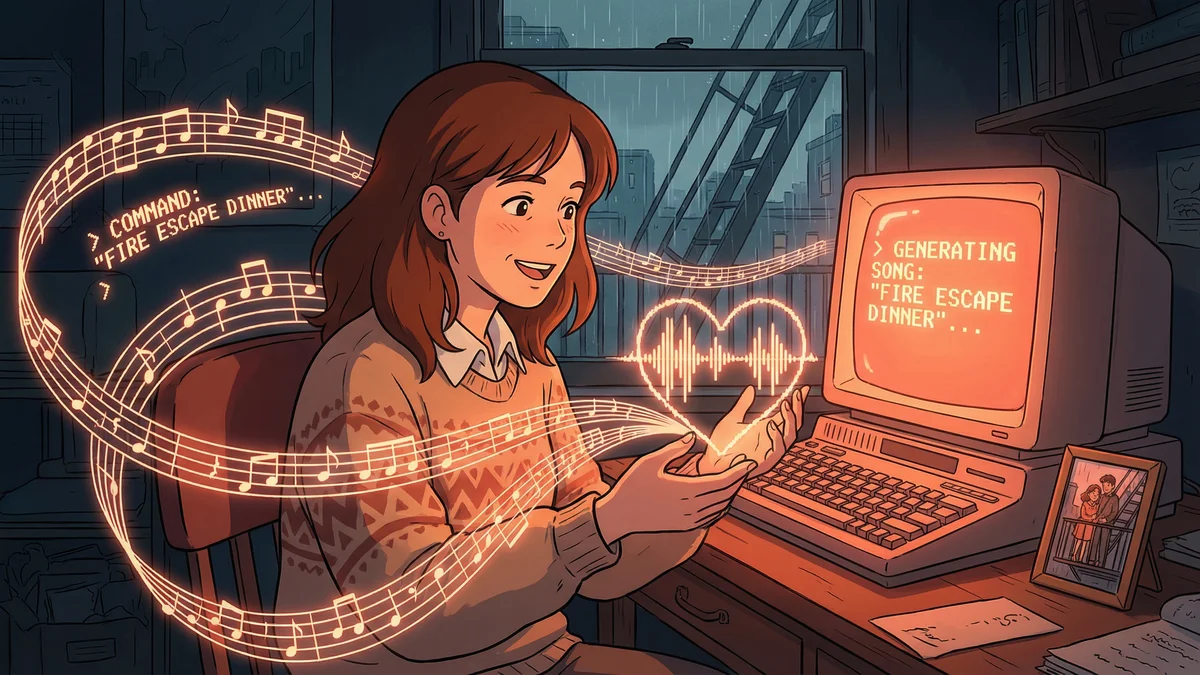
They ate takeout on his fire escape in the rain, laughing about the chaos.
Sarah had tried to capture this in various ways over the years. A scrapbook page. A written memory. Nothing felt right.
What she wanted was a song. Something they could play. Something that would bring them back to that wet fire escape, eating Chinese food, falling in love.
The Impossible Made Possible
Suno AI generates complete songs from text descriptions. Not beats. Not backing tracks. Full songs with lyrics, vocals, and instrumentation.
You describe what you want. The AI makes it.
Sarah had no idea this existed. Her image of AI in music was “computers make beeps.” This was different.
She typed: “A doo-wop style love song about a disastrous first date. He tries to cook, burns everything, the smoke detector goes off. They end up eating takeout on the fire escape in the rain. Sweet, funny, nostalgic.”
The AI generated a song.
It had verses. A chorus. A bridge. It mentioned burnt toast. It mentioned rain. It had harmonies that sounded like something from the 1950s.
Sarah sat at her computer and cried.
The Iteration Process
The first generation wasn’t perfect. Some lyrics didn’t fit. The tone of the bridge was too sad.
So she revised. Suno lets you regenerate sections, adjust prompts, and refine.
“Make the chorus more upbeat. Include a line about fire escapes. The mood should be ‘laughing about it now.’”
New version. Better. Still not quite right.
She kept iterating. Over two hours, she generated maybe fifteen versions, mixing and matching the best parts.
“I wasn’t writing the song. But I was directing it. Every choice felt like mine. Which version of the verse? What emotion in the bridge? How does it end?”
The final song was three minutes long. It told their story. It sounded professional — not AI-generated in any way she could detect.
The Gift
Sarah transferred the song to a USB drive shaped like a guitar (she found it online, of course).
On their anniversary, she gave it to him.
“Play this.”
He did.
She watched his face. The confusion at first. Then recognition. Then the tears.
“I can’t play a note,” Sarah says. “But when he heard that song, he cried. It was funny, sweet, and sounded real. The AI allowed me to express love in a medium I was locked out of my entire life.”
What the AI Actually Does
Suno (and competitors like Udio, Boomy, and others) use generative AI trained on musical patterns.
The system learned from massive datasets of songs — how melodies work in different genres, how lyrics scan with rhythm, how arrangements typically unfold.
When you prompt “doo-wop love song about burnt toast,” the AI:
- Generates lyrics matching the theme and genre
- Creates a melody appropriate to the style
- Arranges instrumentation (backup vocals, bass, drums, etc.)
- Synthesizes the vocals using AI voice models
- Mixes everything into a complete audio file
The result sounds like a real recording because it follows the patterns of real recordings. The AI doesn’t “understand” music in a human sense. It recognizes structure.
For non-musicians like Sarah, this distinction doesn’t matter. What matters is: the output sounds like a song, and she made it happen through her choices.
The “Messy Stems” Reality
Professional musicians note that AI-generated music isn’t ready for studio production. If you tried to separate the tracks (vocals, drums, guitar), they’d be “messy” — audio bleeding between elements, artifacts that sound wrong when isolated.
For hobbyist use, this doesn’t matter. Sarah didn’t need stems. She needed a finished song to give her husband.
But it’s worth understanding: these tools occupy a specific niche. They’re brilliant for personal gifts, background music for videos, thematic songs for events. They’re not replacing session musicians or professional composers.
“Perfect for making a funny song for a friend’s birthday,” as one reviewer put it. “Not for your platinum album.”
Other Use Cases
Sarah’s anniversary song represents one flavor of AI music creation for non-musicians:
TTRPG Character Themes: Dungeon Masters generate theme songs for villains, locations, or story moments. Imagine players walking into the tavern while “their song” plays.
Personalized Focus Music: Some people generate custom concentration music tailored to their preferences. “Ambient electronic, no vocals, slow build, 45 minutes.”
Event Soundtracks: Wedding entrance music. Birthday party jingles. Retirement celebration songs with lyrics about the retiree.
Video Content: YouTubers and TikTokers generate custom background music matching their content’s vibe, avoiding copyright issues.
The common thread: people who have musical ideas but lack the ability to execute them. The AI bridges that gap.
The Deeper Impact
Sarah thinks about what the gift meant, beyond the immediate emotion.
“My whole life, music has been something other people make. I can appreciate it but never participate. This changed that. I directed something. I made choices. The song exists because I imagined it.”
She’s used Suno a few more times since. A silly song for her sister’s birthday. A lullaby for her friend’s baby shower.
“It’s not replacing musicians. It’s giving people like me — people with no training, no talent, no way in — a door.”
Her husband still plays the anniversary song sometimes. It shows up in his Spotify favorites.
“It’s not perfect. Some of the AI’s choices are weird. But it’s ours. That’s the point. Nobody else has this song.”