TL;DR
- AI cut content creation time from 3 hours to 1 hour per client per week
- Grew from 4 clients to 7 (75% growth) without increasing work hours
- Income increased ~50% with same time investment
- Key workflow: AI generates drafts, human adds strategy and polish
- Built “style prompts” for each client to maintain distinct brand voices
AI didn’t replace this social media manager - it tripled her capacity by handling the mechanical production while she focused on strategy and client relationships.
Nina was a freelance social media manager for small local businesses.
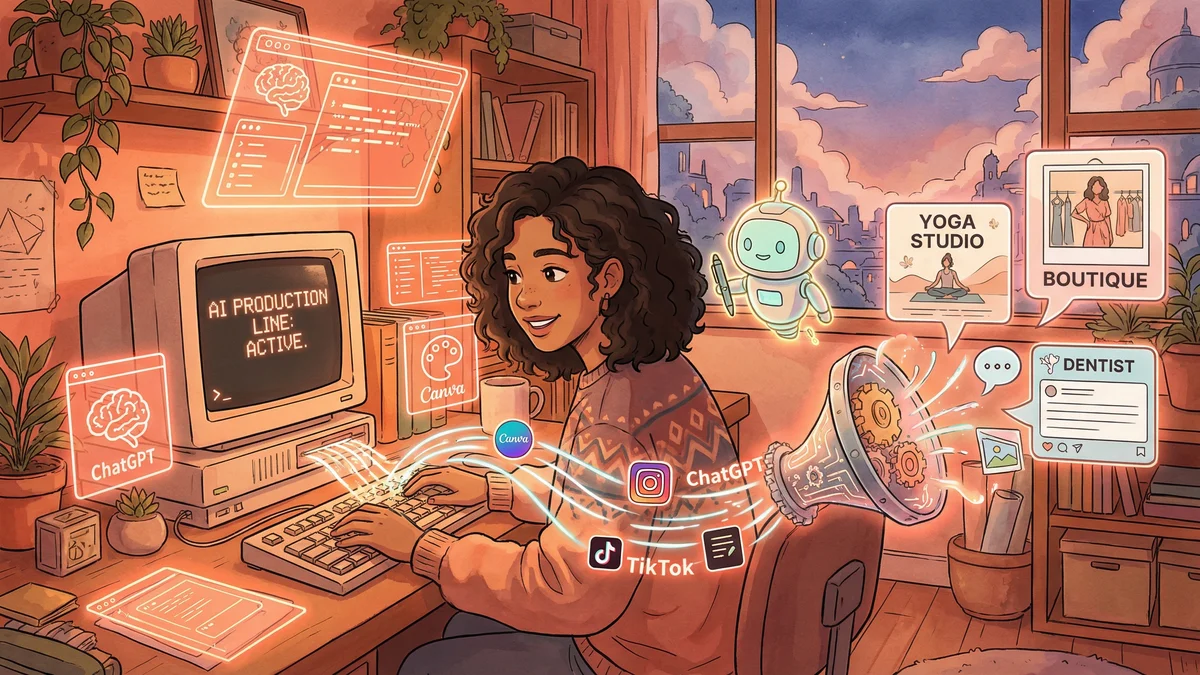
A coffee shop. A boutique. A yoga studio. A dentist. Each needed consistent posting, engaging captions, relevant imagery, and strategic timing.
She could handle four clients. Maybe five if she pushed herself.
Then she discovered what AI could do.
“I was spending three hours per client just on content creation. Brainstorming posts, writing captions, finding images, resizing everything for different platforms. It was the most time-consuming part of the job.”
And it was the most mechanical. The strategic thinking — what to promote, when to post, how to build a brand voice — that was the valuable work. The execution was just… production.
The Content Bottleneck
A typical week for Nina before AI:
Monday: Plan content calendars for all clients (4 hours) Tuesday-Thursday: Create assets — write captions, design graphics, find/edit photos (12+ hours) Friday: Schedule posts and handle engagement (4 hours)
Total: 20+ hours per week, plus the mental overhead of constant switching between brands.
She couldn’t raise prices indefinitely. Local businesses have budgets. But she also couldn’t keep growing at this pace. Adding one more client meant another 5 hours per week she didn’t have.
The ceiling felt fixed.
The AI Production Line
Nina started experimenting with AI tools.
Captions: She’d describe the post she wanted and ask ChatGPT for five variations. Different tones, different lengths, different hook styles. Then she’d pick the best one and refine it.
Images: For clients without photography budgets, Canva’s AI features could generate backgrounds, suggest layouts, and even create simple graphics from prompts.
Repurposing: One piece of content could become many. A blog post became an Instagram carousel became a LinkedIn text post became Twitter threads. AI helped adapt the same core message for different platforms automatically.
Her production time dropped dramatically.
Before AI: 3 hours per client per week on content creation. After AI: 1 hour per client per week on content creation.
Same quality. Same brand voice. Same strategic thinking. Just faster execution.
The Boutique TikTok Explosion
One of Nina’s clients, a local fashion boutique, wanted to try TikTok. They had no budget for video production and no idea what content worked.
Nina used ChatGPT to generate ideas: “30 TikTok concepts for a fashion boutique targeting women 25-40, mixing trends with educational content.”
The AI delivered:
- Styling tips for body types
- “Get ready with me” concepts
- Behind-the-scenes of receiving new inventory
- “How to wear one piece three ways”
- Trend reactions and commentary
- Before/after outfit transformations
Nina had been struggling to brainstorm past the fifth idea. The AI gave her 30 in two minutes.
She executed the best ones with her phone — no fancy equipment. The boutique’s TikTok grew from zero to 5,000 followers in three months.
Result: The boutique retained Nina at a higher rate, impressed by the new platform expertise. Foot traffic from TikTok viewers became measurable.
The Capacity Expansion
With AI handling production, Nina had a choice.
She could work fewer hours and keep the same income.
Or she could work the same hours and take on more clients.
She chose growth.
Within six months, she went from four clients to six, then seven. Her income grew roughly 50% without meaningfully increasing her working hours.
“I’m not working more. I’m working differently. AI does the first draft of everything. I do the strategy and the polish.”
The Quality Multiplier
Interestingly, quality improved along with quantity.
Before AI, Nina would sometimes phone it in on posts. Tired from a long day. Running behind schedule. Just needing to get something posted.
Now, even her “rushed” posts had a solid foundation. The AI draft was always decent. Her polish made it good.
“I used to have maybe 60% of posts where I was really proud of them. Now it’s 80-90%. Because I’m not starting from scratch when I’m exhausted.”
Clients noticed. Engagement metrics climbed. Not dramatically — social media doesn’t work that way — but steadily. Better captions meant more comments. More consistent posting meant better algorithm performance.
The Style Library
Nina developed a system for maintaining distinct voices across clients.
For each client, she built a “style prompt” — a description of their brand voice, typical topics, dos and don’ts. When she asked AI for captions, she included the style prompt.
Example: “You’re writing for a wellness yoga studio. Tone: calm, inviting, non-judgmental. Never: use aggressive sales language or toxic positivity. Often: reference the feeling after practice, community aspects, accessibility.”
The AI’s outputs matched each brand. The coffee shop got playful captions. The dentist got professional but warm. The yoga studio got serene.
“Switching between clients used to require me to shift mental gears. Now the AI shifts gears for me. I just review that it landed right.”
The Danger Zone
Not everything about AI content was perfect.
Once, Nina posted an AI-generated image for a client — a stylized photo that looked great at first glance. A follower commented: “Why does she have six fingers?”
Classic AI image generation error. Nina hadn’t caught it because she reviewed on a small screen.
Another time, an AI-written caption included a phrase that didn’t quite make sense in context. Grammatically correct but semantically off. She’d approved it too quickly.
“AI is fast, not perfect. You can’t turn off your brain. Every piece still needs a human checking that it actually makes sense.”
She built review checklists into her workflow. Image inspection for artifacts. Caption read-through for logical flow. Brand voice confirmation. The checks took five minutes but prevented embarrassing posts.
The Platform Intelligence
Beyond content creation, Nina used AI for platform strategy.
She’d ask questions like: “What types of Instagram posts are getting high engagement in 2025 for small retail businesses?”
The AI would summarize current trends, algorithm changes, and content formats that were working. Not always perfectly up-to-date, but a solid starting point for research.
She’d also ask for analytics interpretation: “Here’s my engagement data for the last month. What patterns do you see?”
The AI might note: “Your carousel posts get 2x the engagement of single images. Your posts at 9am outperform those at 2pm. Educational content performs better than promotional content.”
Nina knew some of this intuitively. But having AI articulate it — and provide a document she could share with clients — added professional polish.
The Business Model
Nina’s services evolved.
She now offered tiered packages:
- Basic: AI-assisted posting with human oversight
- Premium: Full strategy + AI-powered execution
- VIP: Custom content plus consulting
The AI efficiency made her basic tier profitable at lower prices, opening up clients who couldn’t previously afford professional social media management.
Her premium and VIP tiers benefited from AI too — she had more time to invest in strategy because production was faster.
“I used to compete on execution. Now I compete on results. The AI handles execution better than I ever did alone.”
The New Reality
Nina is still a one-person operation.
But she delivers what looks like team output. Seven clients getting consistent, quality content across multiple platforms. Strategies based on data analysis. Quick turnarounds on special requests.
“My clients don’t know how much AI I use. They just know their social media runs well. That’s what they’re paying for — results, not process.”
The ceiling she’d felt before? Gone. She could take on another client if the right one came along. Or she could work a little less and enjoy the same income.
“AI didn’t change my profession. It changed the economics of my profession. I do the work I love — strategy, creativity, client relationships — and AI does the work I tolerated.”