TL;DR
- AI cut product description time from 30 minutes to 3-5 minutes per product
- Conversion rates increased ~18% with consistent, SEO-optimized descriptions
- Enabled 40% more product launches by removing the writing bottleneck
- Key workflow: AI generates base copy, human edits 30% for brand voice
- Organic search traffic grew steadily as every product became an SEO asset
AI removed the writing bottleneck that was killing product launches - and conversions went up. Glitch Anomaly sold streetwear online.
Limited drops. Dozens of new products monthly. Each item needed a product page before launch day — photos, descriptions, sizing info, SEO keywords.
The photos were easy enough. Rent a studio, shoot everything, upload.
The descriptions were the bottleneck.
“Every product needs unique copy. You can’t just say ‘black hoodie’ and expect people to pay premium prices. You need to tell a story. But when you’re launching 40 products in a drop, that’s 40 stories to write.”
The founder had tried several approaches. Writing them himself (burned out). Hiring freelance writers (expensive, inconsistent voice). Using templates (boring, hurt conversions).
None of it scaled.
The Launch Day Crunch
Drop culture creates artificial deadlines.
Products arrive from manufacturing. Photography happens. Then there’s a narrow window to get everything online before the announced launch date.
Miss that window, and customers are refreshing a page that doesn’t exist. Social media hype leads nowhere. The carefully built anticipation fizzles.
“We’d be up until 2am the night before a drop, still writing product descriptions. Typos would slip through. Some pages would go live with placeholder text. It was chaotic.”
The founder once launched a product with the description “INSERT COPY HERE” because someone forgot to update the placeholder.
Embarrassing. Unprofessional. Inevitable when humans rush.
The AI Writer
Shopify Magic arrived as part of the store’s existing platform.
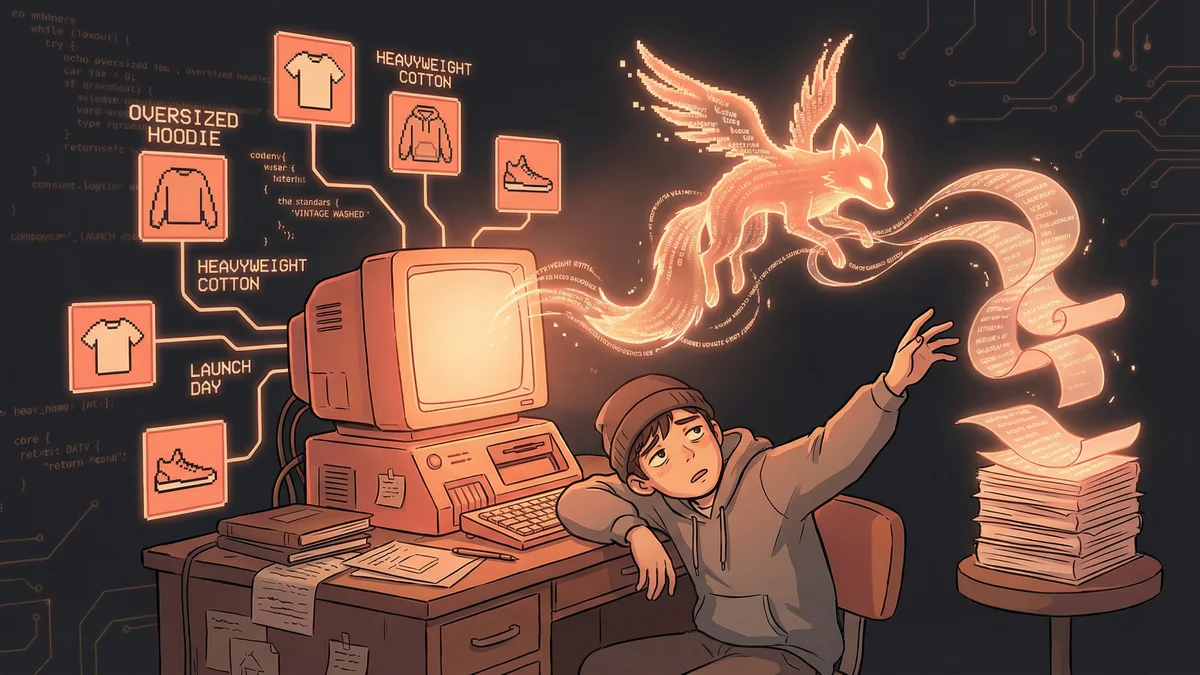
The AI could generate product descriptions from minimal input. Give it a few keywords — product type, material, style, vibe — and it produced polished copy.
The founder tested it skeptically.
Input: “Oversized hoodie, heavyweight cotton, vintage washed, relaxed fit, earth tones”
Output: “Built for those who know comfort is non-negotiable. This heavyweight cotton hoodie wraps you in vintage-washed texture that feels broken-in from day one. The oversized silhouette falls easy, designed for layering or standing alone. Earth tones that pair with anything in your rotation.”
Not bad. Actually pretty good.
More importantly: it took 30 seconds instead of 30 minutes.
The Workflow Transformation
The new product launch workflow:
- Upload product photos
- Enter basic attributes (product type, materials, fit, style keywords)
- Let AI generate initial description
- Review and tweak for brand voice
- Publish
Time per product before AI: 20-30 minutes of writing Time per product after AI: 3-5 minutes of reviewing and tweaking
A 40-product drop that used to require an all-nighter could now be completed in an afternoon. With fewer errors because the founder wasn’t exhausted.
“The AI gave us our nights back. And our launches became cleaner because we weren’t rushing.”
The Conversion Lift
What surprised the founder: the AI descriptions actually performed better.
Conversion rates on product pages increased roughly 18% after switching to AI-generated copy (then human-edited).
Why?
“I think it’s consistency. Before, some products got great descriptions when I had energy. Others got garbage when I was tired. Now everything gets a solid baseline.”
Every product told a story. Every page had SEO-friendly text. Every description was complete and coherent.
Customers noticed. Time spent on product pages increased. Cart additions went up.
The SEO Bonus
Shopify Magic was trained to include keywords that help with search engine visibility.
The founder had never been good at SEO. He knew it mattered but didn’t have time to research keyword density and meta descriptions.
The AI handled it automatically. Product descriptions naturally included searchable terms. Meta descriptions were generated appropriately.
“We started showing up in Google searches we’d never ranked for. ‘Oversized vintage hoodie’ — we were suddenly on page one. The AI was doing SEO I didn’t know how to do.”
Organic traffic grew over the following months. Not explosively, but steadily. Each properly optimized product page was a small SEO asset accumulating value.
The Brand Voice Challenge
The AI’s first drafts weren’t perfect.
They were polished — sometimes too polished. The streetwear brand had an edge, an attitude. The AI wrote like a mainstream retailer.
The founder developed a revision layer.
After AI generated the base description, he’d inject personality. Swap “comfortable” for “stupid cozy.” Add a reference to the design inspiration. Drop in brand-specific language.
“The AI gets me 70% there. The last 30% is what makes it ours.”
This was faster than writing from scratch but preserved the brand voice that customers expected. Generic AI copy wouldn’t work for Glitch Anomaly’s audience. Edited AI copy worked great.
The Variant Problem
One challenge: product variants.
The same hoodie in five colors. The AI wanted to write five nearly identical descriptions. That felt spammy and wasn’t great for SEO (duplicate content).
The founder learned to work around it. He’d have AI generate one base description, then manually add variant-specific notes. Or he’d prompt the AI to specifically differentiate: “Write descriptions for the same hoodie in midnight black versus vintage cream, highlighting how each color affects the vibe.”
The AI could differentiate when asked. It just needed to be asked.
The Scaling Effect
With the description bottleneck removed, Glitch Anomaly could launch more frequently.
Monthly drops became bi-weekly. More products per drop because catalog management was no longer constrained by writing time.
“We probably increased our product output 40% after adopting AI. Not because we could design or manufacture faster — but because we could get things online faster.”
Revenue grew proportionally. More products available meant more purchase opportunities. Faster launches captured trend moments better.
The founder reinvested some savings into product photography, improving visual quality since writing no longer consumed the budget.
The Future Experiment
The founder started exploring other Shopify AI features.
Shopify Sidekick could answer questions about the store’s performance. “Which products have the highest margin?” “What was our conversion rate last month compared to industry average?”
AI-generated email campaigns pulled data from the store to suggest promotions.
“I went from AI writing product descriptions to AI helping me run the whole marketing operation. It just kept expanding once I saw what was possible.”
The Lesson
The founder’s takeaway was simple but important.
“I thought my bottleneck was creativity. Turns out it was production. The creative ideas were there — I knew what products I wanted to sell and how I wanted to position them. I just couldn’t physically write fast enough.”
AI removed the production constraint. The founder could focus on creative direction, brand building, customer relationships — the things only he could do.
“I’m not an AI company. I’m a streetwear company that uses AI as a tool. The tool handles the grunt work. I handle everything else.”