TL;DR
- Merlin Bird ID uses AI to identify bird species from audio in real-time, no internet needed
- Reveals an invisible layer of nature that casual hikers miss entirely
- App trained on millions of recordings from Cornell Lab’s Macaulay Library
- Best for: hikers, nature lovers, anyone curious about wildlife around them
- Key lesson: AI doesn’t replace learning, it accelerates it by making the invisible visible
Merlin Bird ID transforms casual hikers into birders by revealing the invisible soundscape of species hiding in plain hearing.
Elena wasn’t a birder. She was a hiker who liked quiet trails.
The woods were peaceful. Birds sang somewhere in the trees. She didn’t think much about it — background noise, pleasant but anonymous.
Then she downloaded Merlin Bird ID on a whim.
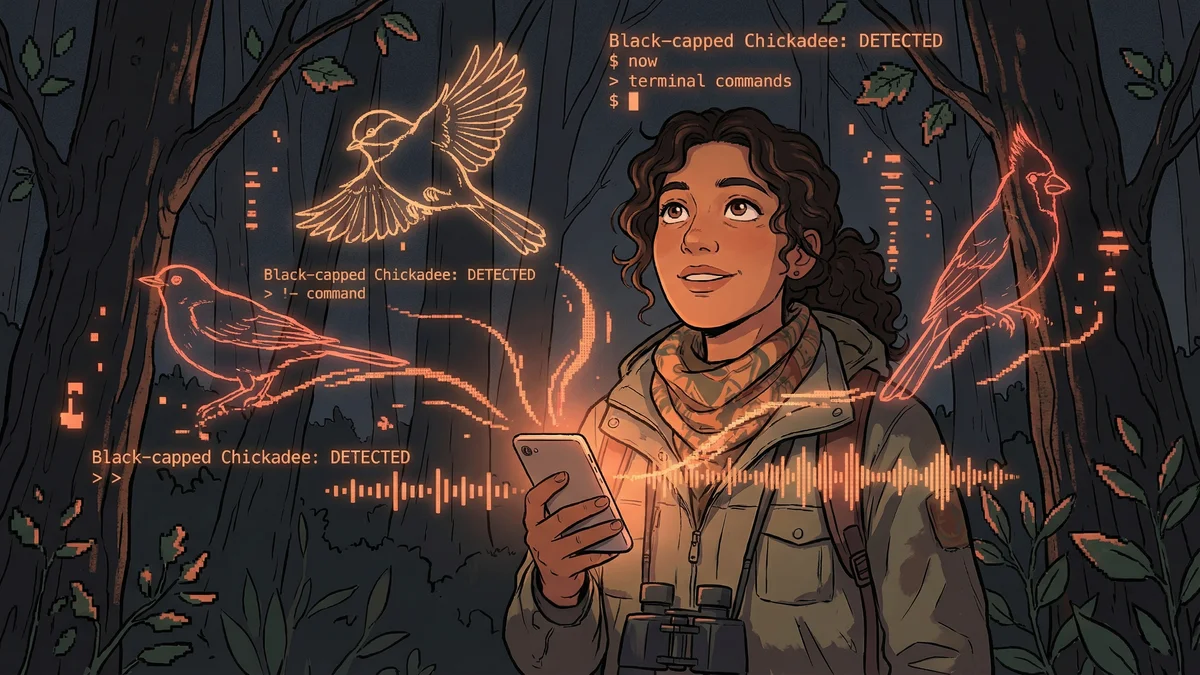
Standing in what she’d always considered a “quiet” forest, she held up her phone and activated Sound ID.
The app lit up with names: Black-capped Chickadee. White-breasted Nuthatch. Tufted Titmouse. American Robin. Northern Cardinal. Red-bellied Woodpecker.
Six species. All around her. All invisible.
“Suddenly the ‘quiet’ woods were full of life,” Elena says. “It changed how I walk. I’m not just hiking anymore. I’m listening.”
The Audio Layer Nobody Sees
Humans are visual creatures. We notice what we can see — a deer crossing the trail, a hawk circling overhead.
Birds are everywhere, but we don’t process their sounds as information. It’s pleasant noise, undifferentiated, like wind through leaves.
Merlin breaks that barrier.
The app, built by the Cornell Lab of Ornithology, uses AI trained on hundreds of thousands of bird recordings. When you activate Sound ID, it listens to ambient audio and identifies species in real-time.
The results appear as a scrolling list. Each bird call triggers a species name. Some flash briefly (a single chip note). Others persist (a robin singing its heart out).
For Elena, it was like putting on glasses after years of blurry vision. The soundscape suddenly had structure.
How the AI Hears
Bird identification by sound is genuinely difficult. Many species sound similar to untrained ears. Some birds mimic others. Regional dialects exist.
Merlin’s AI handles this by analyzing audio spectrograms — visual representations of sound that show frequency over time. Each species has characteristic patterns: the rising whistle of a Black-capped Chickadee, the descending trill of a Wood Thrush, the repetitive “cheer-up” of an American Robin.
The model was trained on the Cornell Lab’s Macaulay Library, which contains millions of bird recordings from around the world.
When you activate Sound ID, the app:
- Captures ambient audio
- Converts it to spectrogram format
- Runs it through the trained model
- Displays matches in real-time
All locally on your phone. No internet required once you’ve downloaded your region’s bird pack.
The Joy Discovery
Elena started paying attention on every hike. She’d stop in spots she’d passed a hundred times and discover new species.
“There’s this one section of trail I always rushed through — it’s near a road, not very scenic. But Sound ID picked up a Scarlet Tanager there. I’d never seen one. But it was singing.”
She began recognizing calls without the app. The distinctive “peter-peter-peter” of a Tufted Titmouse. The “wicka-wicka” of a Northern Flicker.
“My hearing actually improved. Or rather, my hearing stayed the same but my brain started processing birdsong as meaningful data instead of background noise.”
The hobby deepened. Elena bought binoculars. She started bringing her phone on hikes specifically to identify birds, not just to play music.
“What kills me is I’d been walking these trails for years. The birds were always there. I just couldn’t hear them — not really hear them, not as individuals with identities.”
The Addictive Quality
Birders call it “getting bitten.” The obsession sneaks up on you.
Elena describes the feeling: “Every walk is now a treasure hunt. The app makes an invisible layer visible. Yesterday I heard something new — the app said Cerulean Warbler. I spent twenty minutes trying to spot it. Never did. But I know it was there. And next time, I’ll recognize that sound.”
The gamification element is subtle but powerful. Each new species feels like an achievement. Seasonal changes bring new possibilities — migration adds species that weren’t there last month.
“My walks are longer now. I’m not trying to cover distance. I’m stopping constantly, listening, wondering what’s in that thicket.”
The Limitations
Merlin isn’t perfect. Research suggests it has a meaningful false-positive rate, especially with:
Mimics: Mockingbirds and starlings imitate other species. Merlin might identify the imitated bird, not the mimic.
Similar calls: Some species sound nearly identical. The AI makes its best guess, but experienced birders use it as a “hint system” rather than definitive proof.
Background noise: Wind, traffic, and human conversation can confuse the model or obscure bird calls.
Overlap: When multiple species sing simultaneously, Merlin may miss quieter birds or mis-identify mixed calls.
Experienced birders verify with their own ears and eyes. They treat Merlin as a starting point: “The app says Wood Thrush — let me listen and confirm.”
For beginners like Elena, these limitations rarely matter. Even with occasional errors, the app reveals more than unaided human hearing ever could.
From Listener to Observer
The Sound ID feature led Elena to Merlin’s visual identification tool. Take a photo of a bird, and the AI identifies it based on appearance.
She started photographing birds she’d first detected by sound. The two skills built on each other.
“I’ll hear something interesting, track the sound to a tree, spot movement, raise my binoculars, identify the species visually, and later confirm with a photo. The app taught me how to look.”
Her phone’s photo gallery transformed. Where it once held selfies and food pics, it now contains hundreds of bird photos — most mediocre, a few gorgeous, all meaningful to her.
“I have a terrible photo of a Brown Creeper climbing a tree trunk. It’s blurry. But I spent thirty minutes tracking that bird after Merlin told me it was nearby. That photo represents an achievement.”
The Depth Keeps Growing
A year in, Elena is a different hiker than she was.
She knows her local species. She can identify the common ones by ear. She gets excited about seasonal arrivals — “The warblers are back!” — and notices when familiar species disappear.
“I used to think of nature as scenery. Pretty, but static. Now it’s teeming with life that I can read. The woods aren’t quiet anymore. They’re having thousands of conversations I finally understand.”
The app sits on her home screen, used almost daily.
“It’s changed my relationship with the natural world more than anything else I’ve ever downloaded. I look at that little bird icon and think: you showed me what was there all along.”