TL;DR
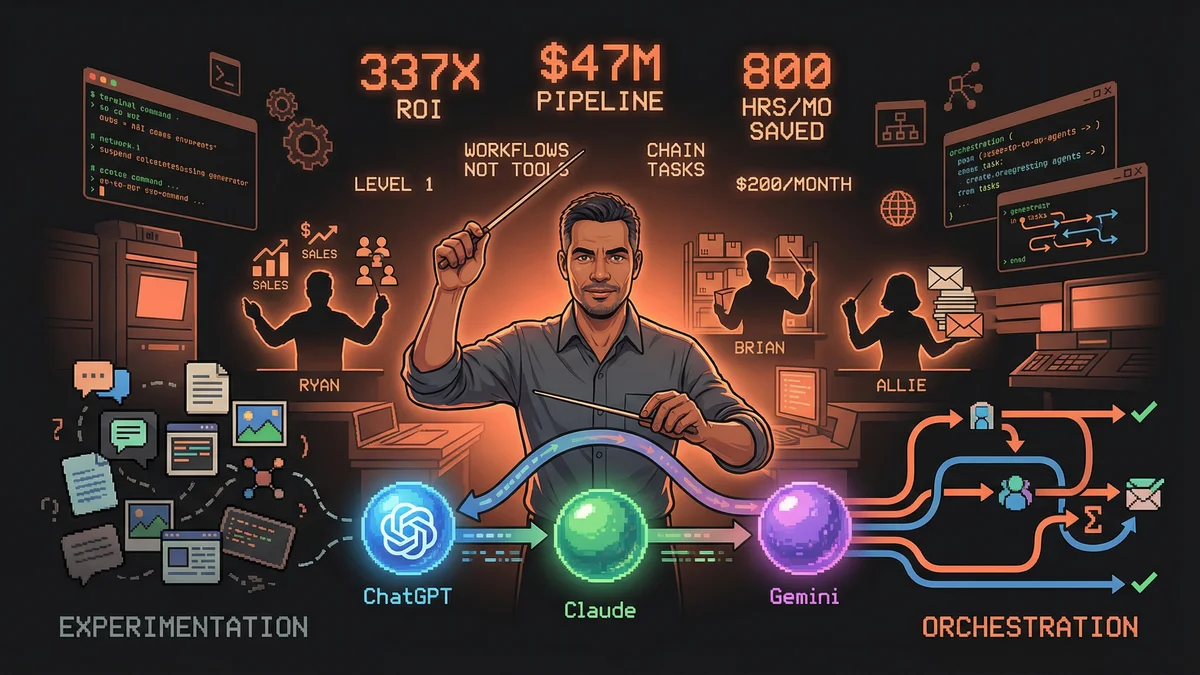
- 337X ROI and 800 hrs/month saved using AI orchestration, not individual tools
- 8-figure Amazon business runs on $200/month Claude subscription with department-level agents
- Physical mail processing eliminated for weeks using one orchestration prompt
- Best for: business owners tired of AI demos that don’t scale
- Key lesson: orchestration (chaining AI tasks) beats experimentation (single prompts)
The biggest lie about AI right now is that there’s no ROI. The truth: most businesses use AI tools in isolation when the value lives in orchestration.
Ryan Staley proved this with a 45-person sales team, Brian Barber built an 8-figure Amazon business on it, and Allie K. Miller eliminated manual mail processing forever. All three share one pattern: they orchestrate AI workflows instead of experimenting with individual prompts.
337X ROI from “Level 1 Only”
Ryan Staley implemented an AI orchestration framework with two revenue teams. The sales team (45 people, 2 months): 337X ROI. 800 hours saved monthly from a single workflow. One $183K deal closed directly from AI-driven insights. Pipeline grew from $32M to $47M.
The framework has three levels. Level 1: Chain AI for multi-step tasks (prompt engineering). Level 2: Connect AI to systems (CRM, email, databases). Level 3: Trigger AI from signals (new lead → auto-research → personalized email).
The sales team used Level 1 only. No complex integrations. No custom software. ChatGPT, Gemini, Copilot, Claude — chained together for workflows instead of isolated tasks.
“The biggest lie in AI right now is that there’s no ROI,” Ryan wrote. “There’s massive ROI. Most companies just don’t have the structure to capture it. They’re using AI tools in isolation when the value lives in ORCHESTRATION.”
The marketing team (18 people): 177 hours saved monthly, $50K cost avoidance, battle cards that used to take a week now done in hours, entire advisory firm fees eliminated.
All from Level 1. Imagine Level 3.
$200/Month Running 8-Figure Revenue
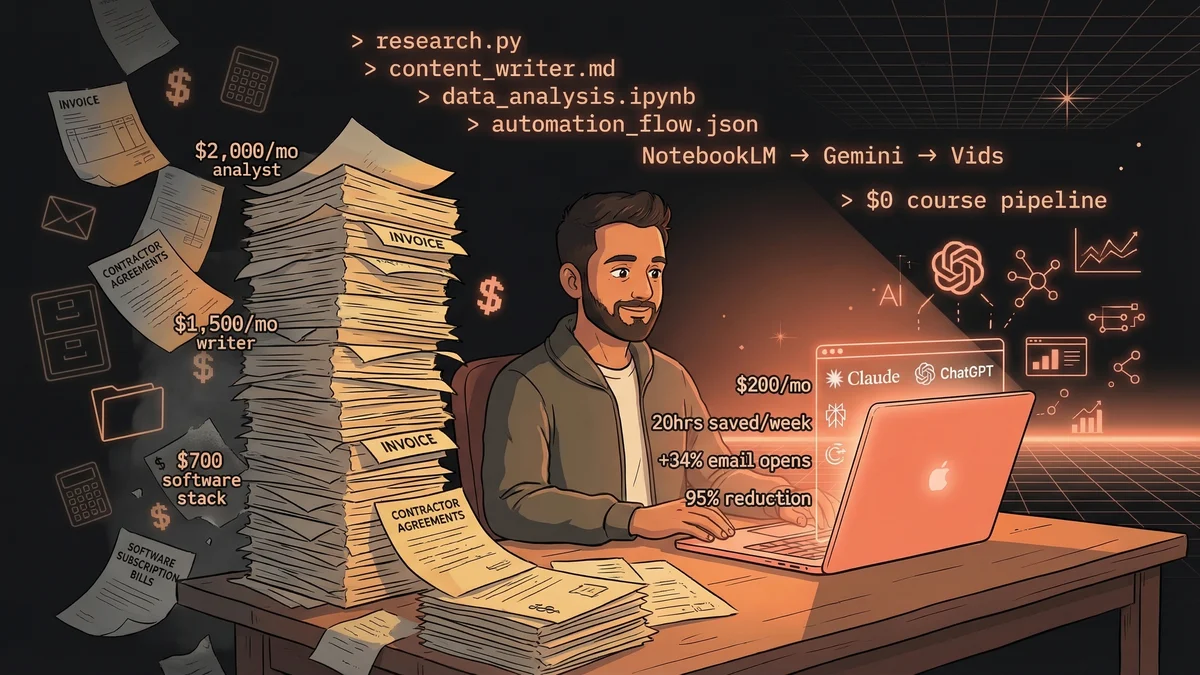
Brian Barber runs an 8-figure Amazon e-commerce business on a $200/month Claude subscription and a single AWS EC2 instance. Not a Mac Mini tower. Not a stack of servers. One subscription.
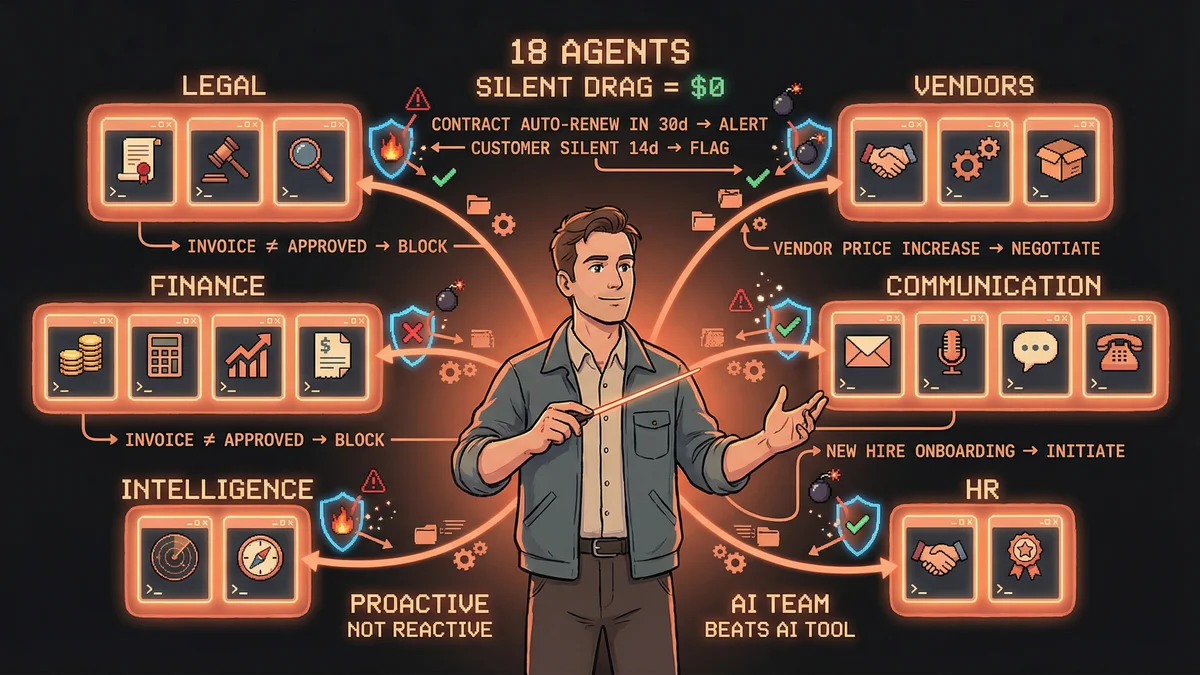
520 API endpoints. 395,000 products tracked on Amazon. Warehouse management. Automated invoicing. Supplier negotiations. B2B sales inquiries. All orchestrated through department-level AI agents.
Procurement agent manages suppliers. Sales agent handles B2B. Warehouse agent optimizes picking routes. Each agent has its own persona, data access, and decision authority.
“We’re not running AI demos,” Brian said. “We’re running a real company with real revenue and real customers on AI infrastructure.”
The setup isn’t experimental. It’s production. The agents don’t assist — they operate. The cost isn’t speculative — it’s $200/month replacing what used to require multiple full-time roles and enterprise software stacks.
Orchestration at scale: department agents coordinating across procurement, sales, and logistics. Not one AI doing one thing. A workforce doing everything.
Zero Manual Mail in Weeks
Allie K. Miller built a single prompt that eliminated manual mail processing. Every piece of physical mail: categorize, compare bills to cheaper providers, flag deadlines, queue payments, calendar events, auto-sort junk (unless the credit card sign-up bonus is worth it).
She hasn’t manually processed mail in weeks.
The prompt doesn’t just “help” with mail. It handles the entire workflow: photo → categorization → price comparison → action queue → calendar sync → payment scheduling. That’s orchestration.
“The physical world is AI’s most underrated context opportunity,” Allie wrote, “and most people haven’t caught on yet.”
She uses the same orchestration pattern everywhere: Korean supermarket (photo → snack recommendation), Australian pharmacy (photo → Dramamine equivalent), old washer manual (photo → troubleshooting steps).
One prompt, multi-step workflow, zero manual intervention.
The Pattern
Ryan orchestrates AI across sales workflows to generate 337X ROI. Brian orchestrates department agents to run 8-figure operations on $200/month. Allie orchestrates physical-world tasks to eliminate manual processing.
None of them are “experimenting with AI.” They’re orchestrating workflows.
The difference: experiments test individual AI capabilities. Orchestration chains capabilities into systems that replace entire job functions.
Experimentation asks “Can AI write this email?” Orchestration asks “Can AI handle the full inbox → triage → draft → send → follow-up → CRM update loop?”
That’s where the ROI lives. Not in the individual task, but in the orchestrated workflow that no longer needs a human in the loop.
Level 1 orchestration — just chaining prompts across tools like ChatGPT and Claude — already generates 337X returns. Most businesses haven’t started.