TL;DR
- AI processes 50+ academic papers and produces summaries, themes, and research gaps
- Literature review preparation compressed from 2-3 weeks to a few hours
- Output: structured outlines, comparison matrices, gap analyses with source citations
- Best for: PhD students, researchers, grant writers facing large reading backlogs
- Critical rule: verify any specific claim before citing—AI summaries can contain errors
AI literature review agents can read and synthesize 50 academic papers in hours, identifying themes and gaps that would take weeks to discover manually.
Dr. Chen had a problem that every researcher knows too well.
Fifty PDFs sat in her downloads folder. Papers on machine learning interpretability - the reading she needed to do before writing her literature review. At 20-30 pages each, that was roughly 1,200 pages of dense academic text.
Two weeks of reading, minimum. And that’s just the reading - not the synthesis, not the comparison, not the actual writing.
She’d been putting it off for a month.
The Research Bottleneck
Academic research has a structural problem: the literature grows faster than humans can read it.
Every field publishes thousands of papers per year. Staying current is impossible. Doing a comprehensive literature review requires reading hundreds of sources. The limiting factor isn’t intelligence or skill - it’s time.
And here’s the cruel irony: the reading phase produces no output. You consume papers for weeks, and at the end you still have a blank page. The actual writing hasn’t started.
This is the bottleneck AI agents are built to break.
The Agent Approach
Dr. Chen pointed Claude Code at her folder of PDFs:
"Read all 50 papers in this folder.
For each paper, extract:
- Main research question
- Methodology used
- Key findings
- Limitations acknowledged
- How it relates to interpretability

Then:
- Identify common themes across papers
- Note contradictions between studies
- Find gaps - what questions aren't being addressed?
- Organize everything into a literature review outline"
She went to teach her 2pm class. When she came back, she had:
- A summary document with key points from all 50 papers
- A thematic analysis grouping papers by approach
- A list of methodological contradictions
- Three identified research gaps
- A suggested structure for the literature review
Not a finished review. But a foundation. The weeks of reading compressed into hours.
What the Agent Actually Does
Here’s the process, demystified:
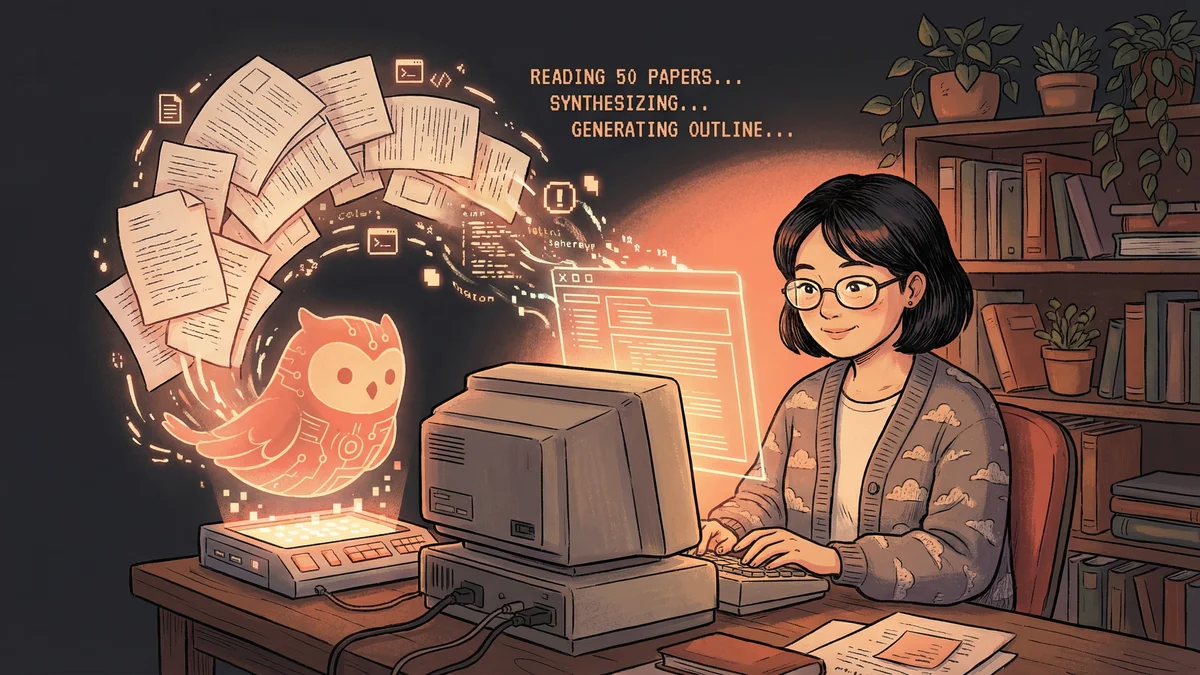
Phase 1: Reading The AI processes each PDF sequentially. Modern language models can handle long documents - a 30-page paper fits within their context window. For each paper, it extracts the relevant information based on your criteria.
Phase 2: Pattern Recognition With all papers processed, the AI looks for patterns. Which methods appear repeatedly? Which findings align or conflict? What topics are over-studied? What’s missing?
Phase 3: Synthesis The AI organizes findings into a coherent structure. Not just summaries - relationships. Paper A’s findings support Paper B but contradict Paper C on a specific point.
Phase 4: Output You get structured notes, an outline, or a draft - whatever you requested. Crucially, each claim links back to its source.
The Prompt Templates
Basic Literature Summary:
"Read all PDFs in [folder].
For each paper, create a 200-word summary covering:
- Research question
- Method
- Key findings
- Relevance to [your topic]
Save as a markdown document with citations."
Comparative Analysis:
"Read these papers on [topic].
Create a comparison matrix:
- Rows: Each paper
- Columns: Methodology, sample size, key findings, limitations
Export as a spreadsheet."
Gap Identification:
"Analyze this collection of papers on [topic].
Identify:
1. Questions that multiple papers mention but don't answer
2. Methodologies that haven't been tried
3. Populations or contexts not yet studied
4. Contradictions that need resolution
Format as a 'Future Research' section."
Theme Clustering:
"Read these papers and group them by:
- Theoretical approach
- Methodology type
- Application domain
Create a visual map (text-based) showing how papers cluster."
The “Don’t Trust, Verify” Protocol
Here’s what researchers learn quickly: AI summaries can be wrong.
The agent might misinterpret a finding. Miss a crucial limitation. Hallucinate a claim that doesn’t exist in the source.
The solution isn’t to abandon the tool. It’s to use it correctly:
Use AI for first pass, not final word. The agent identifies which papers deserve your close attention. It doesn’t replace reading the important ones.
Verify anything you cite. Before putting a claim in your literature review, check the original source. The AI gives you page references - use them.
Trust patterns more than specifics. “These papers generally support X” is more reliable than “Paper Y found exactly Z.” Patterns across many papers are robust; specific claims need verification.
Keep the receipts. Ask the agent to note where each claim comes from. If something seems wrong, you can check.
Beyond Literature Reviews
Once you have an agent that reads academic papers, other applications emerge:
Research Proposal Support:
"Read these papers on [topic].
Identify the most promising research direction that:
- Builds on existing work
- Addresses an identified gap
- Is feasible with [available resources]
Draft a research question and brief methodology."
Grant Writing:
"Analyze the current state of research on [topic].
Write a 'Background and Significance' section that:
- Establishes what's known
- Identifies the gap
- Positions my proposed research
Use citations from these sources."
Teaching Preparation:
"Read these seminal papers on [concept].
Create a lecture outline that:
- Explains the core idea to undergraduates
- Highlights the key studies
- Notes current debates
- Suggests discussion questions"
The Tools for the Job
Claude Code/Cowork: Best for local PDF processing. Mount your paper folder, and Claude reads directly without uploading to external servers. Good for unpublished or sensitive research.
ChatGPT with File Upload: Upload PDFs to the conversation. Good for smaller numbers of papers. The interface is more conversational.
Specialized Tools: Services like Elicit, Semantic Scholar, and Connected Papers offer AI-powered literature review features specifically designed for academic work.
The Real Transformation
Dr. Chen finished her literature review in three days instead of three weeks.
Not because the AI wrote it for her. But because the AI handled the reading phase - the bottleneck that kept her from starting.
She still read the key papers herself. She still made the interpretive choices. She still wrote in her own voice.
But the mountain of unread PDFs? The weeks of preliminary reading? The paralysis of not knowing where to start?
Gone.
The agent didn’t replace her expertise. It amplified it. She spent her time on what humans do best: interpretation, judgment, writing.
The reading? She outsourced that to a machine that doesn’t get tired.