TL;DR
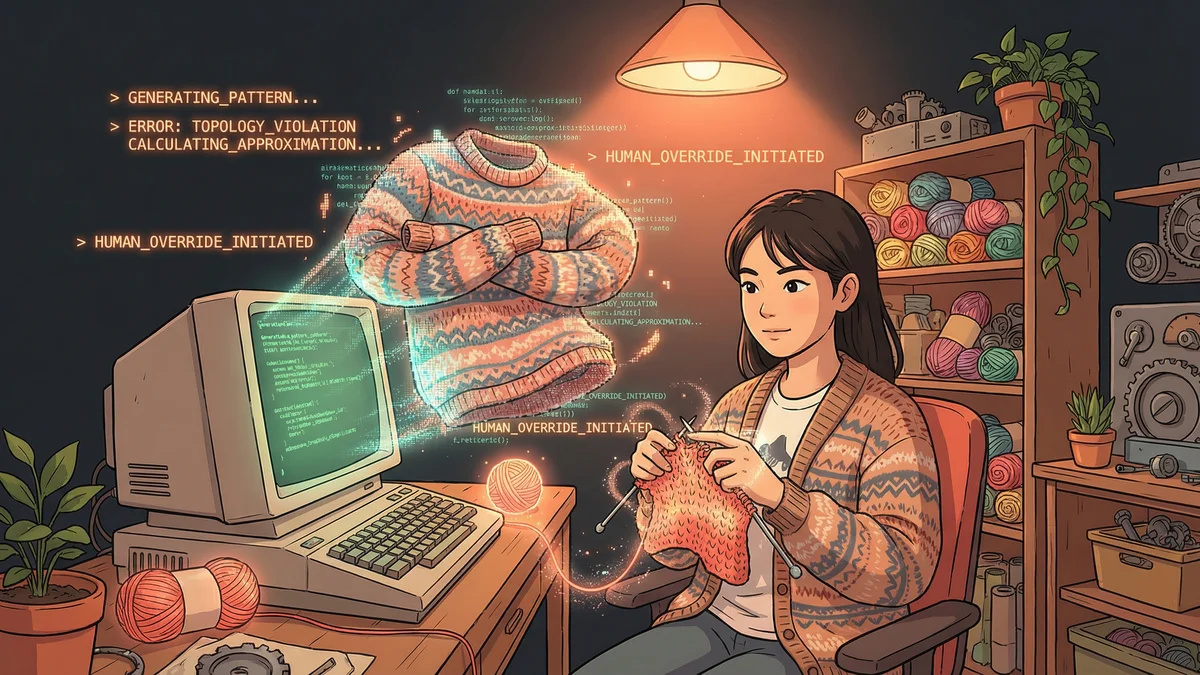
- AI image generators create stunning craft images that violate physical laws of yarn and topology
- These “patterns” look beautiful but cannot be physically made
- AI excels at photo-to-chart conversion, technique explanations, and pattern calculations
- Best for: understanding AI limitations in physical crafts, using AI appropriately for craft assistance
- Key lesson: label AI-generated images and use craft-specific tools for actual patterns
AI image generators create knitting and crochet patterns that look gorgeous but violate the laws of physics, causing chaos in craft communities.
The image looked stunning.
An intricate crochet dragon, coiled and majestic, photographed on a living room shelf. The detail was incredible — individual scales, textured wings, a sinuous tail.
The knitting forum erupted. “Pattern please!” “Where did you get this?” “I need to make one!”
Then someone noticed the problem.
The scales merged into the neck at impossible angles. The wings attached to nothing visible. The construction would require yarn to pass through solid yarn — violating basic topology.
The dragon wasn’t real. It was AI-generated. And it couldn’t physically exist.
The Hallucination Epidemic
AI image generators like Midjourney and DALL-E are remarkable at producing beautiful images. They’re terrible at understanding how physical objects work.
For most use cases, this doesn’t matter. A fantasy landscape doesn’t need to follow engineering principles.
For crafts, it’s catastrophic.
Knitting, crochet, sewing, and quilting are constrained by physical reality. Yarn follows rules. Stitches connect in specific ways. Topology — the mathematical study of how surfaces connect — determines what’s possible.
AI doesn’t understand topology. It generates images that look like textiles but violate how textiles actually work.
The result: “patterns” that look gorgeous in pictures but can’t be made.
The Anatomy of an Impossible Pattern
An AI might generate a knitted sweater with:
- Cables that twist in directions cables can’t twist
- Colorwork where colors change mid-stitch
- Ribbing that somehow transitions into stockinette without visible seams
- Sleeves that attach at angles requiring fourth-dimensional yarn
- Surface textures that would require the yarn to pass through itself
To non-crafters, these images look fine. The AI has seen thousands of sweater photos and can recombine elements convincingly.
To experienced knitters, they’re obviously wrong. “That’s not how yarn works” is the polite version of the reaction.
The Community Chaos
The craft communities experienced a specific sequence:
Phase 1: Wonder Gorgeous images appeared on forums. “Look at this amazing project!” People marveled and requested patterns.
Phase 2: Realization Sharp-eyed crafters noticed impossibilities. “Wait, how does that cable work?” “That stitch construction doesn’t exist.”
Phase 3: Investigation Reverse image searches. Analysis of image artifacts. Confirming: AI-generated, not real.
Phase 4: Frustration Hours spent admiring and discussing imaginary projects. Requests for patterns that couldn’t exist. Trust erosion in the community.
Phase 5: Paranoia Every new project photo scrutinized. “Is this real?” Real crafters feeling suspected. The friendly atmosphere curdling.
One crochet forum temporarily banned AI discussion entirely because it was “derailing the helpful, friendly atmosphere.”
The Flip Side: Challenge Accepted
Some crafters responded differently.
When an AI generated the “Klein Bottle Hat” — a pattern that would be mathematically impossible to knit in 3D space — a subset of the community asked: Can we try anyway?
The Klein bottle is a topological object that exists in 4D. In 3D, it would have to pass through itself. The AI image showed a hat that seemed to do exactly this.
Obviously, actual knitting can’t create a Klein bottle. But approximations? Illusions?
Adventurous knitters started experimenting. How close could they get? What tricks might create the visual effect even if not the mathematical reality?
The AI’s impossibility became inspiration. Not a pattern to follow, but a puzzle to solve.
What AI Can Actually Do for Crafters
Strip away the hallucinated impossible patterns, and AI offers genuine value to crafters:
Photo-to-Chart Conversion: Apps like Pixelcut convert images into pixel grids suitable for cross-stitch or colorwork knitting. Upload a photo of your dog, get a chart you can actually knit into a blanket.
The AI handles color quantization (reducing millions of colors to workable palette), grid mapping, and pattern sizing. The output follows physical rules because it’s constrained to them.
Technique Explanations: “Explain the Kitchener stitch bind-off” gets you a tutorial. “What’s the best decrease for a raglan sleeve?” gets you options. AI excels at synthesizing technique information.
One knitter asked Google’s Bard for the best bind-off method for a specific situation. The suggestion — Kitchener bind-off — was new to her. She tried it and found it “sturdy with a nice aesthetic.” AI as technique teacher worked.
Pattern Modifications: “How do I adjust this hat pattern for a child’s size?” involves math. AI handles the calculations, converting stitch counts and row numbers for different gauges and sizes.
Project Planning: “How much yarn do I need for a queen-size blanket in worsted weight?” requires estimation. AI can approximate based on typical yarn consumption rates.
The Trust Economy
Craft communities run on trust. People share projects, others celebrate and learn from them. The social contract assumes authenticity.
AI-generated images broke that contract. Not because AI is bad, but because some users didn’t disclose.
The emerging norm: explicit labeling.
“Planning my quilt with AI — image is a mockup” tells the community this is conceptual.
“Finished quilt I sewed” claims physical reality.
The problem was never AI existence. It was ambiguity. Once labeling became standard, communities could distinguish between inspiration images and actual projects.
The Craft Remains Human
The impossible sweater controversy revealed something important: the craft itself resists automation.
A knitted sweater is valuable because someone made it. The hours of work. The skill accumulated over years. The choices made stitch by stitch.
An AI can generate a picture of a sweater. It cannot generate the sweater itself, nor the experience of making it, nor the meaning of wearing something made by human hands.
“A knitted sweater is valuable because of the hours spent making it,” one crafter wrote. “An AI-generated image of a sweater has no warmth.”
This isn’t anti-AI sentiment. It’s clarity about what craft is.
AI can help with craft logistics — calculations, techniques, inspiration. It cannot replicate the craft experience itself.
The Current State
Craft communities have mostly stabilized. The norms are clearer now:
AI-assisted content is welcome — use AI to plan, calculate, learn techniques, generate charts from images.
AI-generated images should be labeled — if you’re sharing an AI image as inspiration, say so.
Real projects deserve real documentation — when you share a finished piece, share process photos, yarn details, pattern credits.
The impossible patterns remain impossible — but they’ve inspired some clever approximations.
The dragon? Still can’t be crocheted. But someone made a surprisingly good attempt at the general concept, using their own engineering to solve problems the AI never understood.
“The AI showed me what I wanted,” they wrote. “I had to figure out how to actually make it.”