TL;DR
- A 4-person HVAC company recovered $2-3K monthly revenue by eliminating voicemail with AI phone answering
- AI receptionist costs $200/month but returns roughly 10x in recovered jobs
- System answers calls, collects customer info, and books appointments automatically
- Best for: service businesses where missed calls mean lost revenue to competitors
- Key lesson: in emergency services, answering first often matters more than price
A small HVAC company recovered $2,000-3,000 per month in lost revenue by replacing voicemail with an AI receptionist that costs $200/month and answers every call.
Alex ran a four-person HVAC repair company.
Four technicians in the field. One of them was Alex himself. No receptionist. No office manager. Just phones that rang while everyone was elbow-deep in ductwork.
“I’d be installing a furnace, covered in dust, and my phone would ring. Customer with a broken AC in the middle of July. If I answered, I lost focus on the job. If I didn’t answer, I probably lost the customer.”
Voicemail wasn’t a solution. Homeowners with broken HVAC systems don’t leave messages. They call the next company on Google until someone picks up.
Every missed call was potentially hundreds of dollars in lost revenue.
The Voicemail Graveyard
Alex tried to quantify the problem.
He pulled his phone records. Roughly 30% of incoming calls went to voicemail during working hours. These weren’t spam calls — they were local numbers, probably homeowners with problems.
Some left messages. Most didn’t.
“I’d call them back two hours later and they’d already hired someone else. Or they wouldn’t answer because they’d moved on.”
The urgency of HVAC problems works against the service provider. When it’s 95 degrees and the AC is dead, customers don’t wait. They call until someone answers.
Alex estimated he was losing 5-10 jobs per month purely to missed calls. At an average job value of $300-500, that was $1,500-5,000 in monthly revenue walking away.
The AI Receptionist
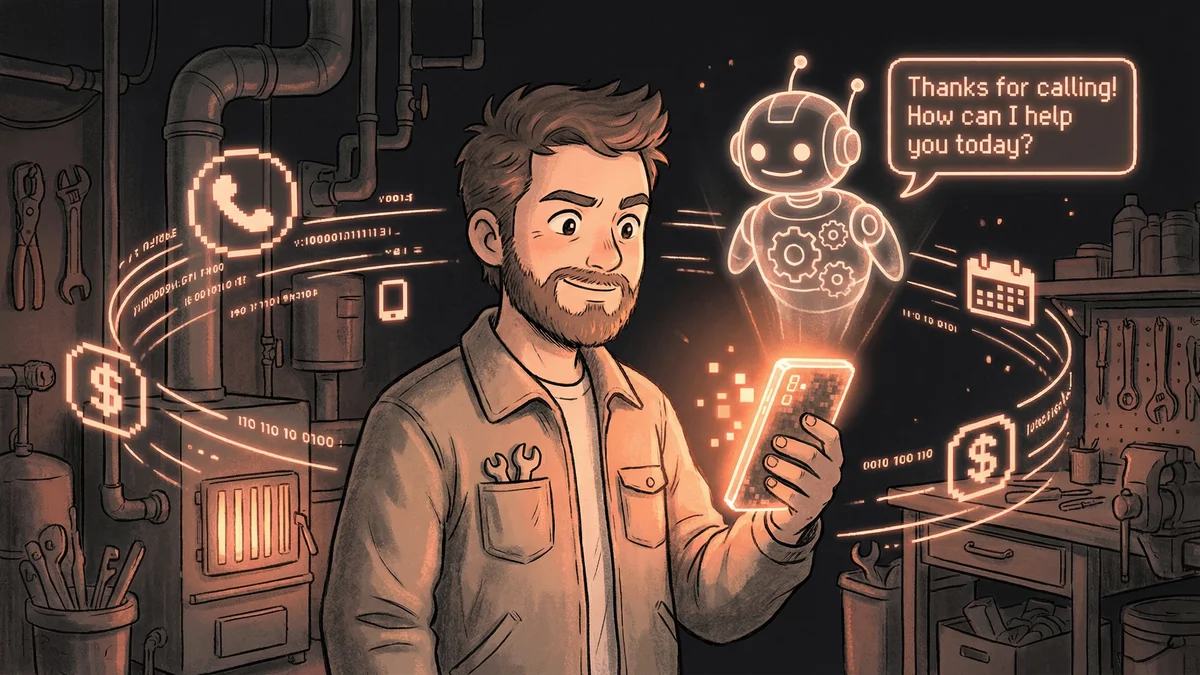
Alex added an AI-powered phone answering service integrated with his scheduling system.
When a call came in and no one was available, the AI picked up: “Thanks for calling [Alex’s HVAC]. How can I help you today?”
The AI could:
- Answer common questions (hours, service area, emergency availability)
- Collect information about the customer’s problem
- Book routine appointments directly into the calendar
- Take detailed messages for complex situations
All in a conversational, natural-sounding voice.
A customer calling about a broken furnace would hear: “I’m sorry to hear that. Let me get some information to help you. What’s your address? What symptoms are you noticing? When did the problem start?”
The AI collected everything a human receptionist would ask, then either booked an appointment (if the scheduling rules allowed) or texted Alex with a summary.
The First Week
The results were immediate.
Week one: The AI handled 47 calls. Of those, 12 became booked appointments without any human involvement. Another 18 were detailed messages that Alex followed up on within hours.
No calls went to voicemail.
More importantly, the AI answered on the first ring. Customers didn’t experience hold times or busy signals. They got an immediate response that felt professional and attentive.
“I got a callback from a customer who said, ‘Your receptionist was really helpful.’ I didn’t have the heart to tell them it was a robot.”
The Revenue Recovery
After two months, Alex ran the numbers.
Jobs booked that previously would have been lost to voicemail: approximately 5-7 per month.
Additional revenue from those recovered jobs: roughly $2,000-3,000 per month.
Cost of the AI phone service: approximately $200 per month.
ROI: roughly 10x the cost.
The math was overwhelming. Every dollar spent on AI receptionist returned roughly ten dollars in recovered revenue. Not from new marketing. Not from advertising. Just from answering calls that were already coming in.
The Scheduling Optimization
The AI did more than answer phones.
Alex also integrated AI-powered scheduling that optimized technician routes. The system looked at job locations, estimated durations, and traffic patterns to minimize drive time.
Before AI scheduling: Technicians crisscrossed town. A job in the north, then the south, then back north. Inefficient but felt fine because they were busy.
After AI scheduling: Jobs clustered geographically. Morning routes in one area, afternoon in another.
Results:
- Gas costs down approximately 15%
- Each technician completing roughly one extra job per week (due to less driving)
- Customer arrival windows became more accurate
One extra job per week, times four technicians, times $300 average job value: $1,200 per week in additional capacity.
The Customer Experience
Customers noticed the improvement.
Arrival time estimates became more accurate because the AI accounted for realistic travel times between jobs. Fewer “running late” calls. Fewer angry customers who’d blocked out their afternoon for a technician who showed up at dinner time.
Automated text updates kept customers informed. “Your technician is on the way and should arrive in approximately 25 minutes.”
“We started getting comments on reviews. ‘Good communication.’ ‘Showed up when they said they would.’ ‘Easy to schedule.’ None of that was me being better at communication. It was the AI handling it automatically.”
The Stress Reduction
Beyond revenue, Alex got his sanity back.
The constant phone interruptions had been destroying his focus. He couldn’t concentrate on a complex installation because his phone might ring at any moment. He felt guilty ignoring calls but also guilty about poor quality work from distraction.
With AI handling initial calls, his phone only rang for messages that truly needed his attention. Complex technical questions. Angry customers. Situations the AI correctly escalated.
“I used to dread my phone ringing. Now it rings maybe five times a day with things that actually need me. The rest is handled.”
His stress levels dropped noticeably. His work quality improved because he could focus. His technicians were happier because they weren’t constantly being pulled away from jobs either.
The Competitive Edge
Alex’s competitors still sent calls to voicemail.
When a homeowner with a broken AC called three HVAC companies on a hot Saturday afternoon, Alex’s company answered first. The others returned calls hours later, if at all.
“I’m not the biggest company. I don’t have the most advertising. But I answer my phone. That’s my competitive advantage now.”
In an industry where responsiveness often matters more than price, AI made a small company act like a big one.
The Learning Curve
Implementation wasn’t instant.
The AI initially booked appointments in slots Alex had intended to keep blocked for emergencies. He had to adjust the scheduling rules.
A few customers were confused by the AI voice and asked to speak to a human. The AI learned to offer that option earlier in conversations.
One customer complaint: the AI was “too cheerful” about a gas leak situation. Alex adjusted the tone settings for emergency-type calls.
“It took maybe two weeks of tweaking before the AI felt like part of the team. After that, I stopped thinking about it. It just works.”
The New Normal
Alex still runs a four-person shop. He still gets dirty installing furnaces. His phone still rings.
But the phone is no longer a liability. It’s an asset.
Every call gets answered. Every opportunity gets captured. Every customer gets a professional first impression.
“I used to think I needed to hire a receptionist to grow. Turns out I just needed AI that could do what a receptionist does — answer questions, book appointments, take messages — but available 24/7 and never calling in sick.”
His revenue grew without adding staff. His stress dropped without reducing workload. His customers got better service without higher prices.
“The AI didn’t change what we do. It just made sure more people could access what we do.”