TL;DR
- Solo HR consultant compressed 3-week employee handbook projects into 4 days using AI
- Increased client capacity by 40% without extending working hours
- AI handles first drafts and data analysis; human expertise drives customization and strategy
- Best for: consultants and freelancers selling expertise-based deliverables
- Key lesson: AI removes the blank-page problem so you can focus on high-value judgment work
A solo HR consultant cut employee handbook delivery time from 3 weeks to 4 days using AI for first drafts, enabling 40% more client work without burnout.
Maria was a one-person HR consulting firm.
She advised small businesses on policies, compliance, and people management. Good work, steady clients, respectable income.
The problem was scale. Her expertise was in her head, and there were only so many hours in her day to get it onto paper.
“A client would ask for an employee handbook. I’d quote 3-4 weeks and $5,000. Half of them would balk at the price. The other half would hire me, and I’d spend nights and weekends writing policy after policy.”
Employee handbooks are notorious time sinks. Dozens of sections. Legal language. Company-specific customization. Every page requires care because every page could be referenced in a future dispute.
Then Maria found AI.
The Document Factory
Her first AI experiment: drafting the dress code section for a tech startup client.
She prompted ChatGPT: “Write a dress code policy for a casual tech startup, friendly tone, emphasizing personal judgment over strict rules.”
The AI returned a polished paragraph in seconds. Not perfect — a bit too generic — but a solid foundation.
She edited for the client’s specific culture, added a few lines about client-facing situations, and called it done.
Time spent: 15 minutes. Previous time for dress code sections: 1-2 hours.
“I stared at that draft thinking about all the blank pages I’d fought with over the years. All those hours wrestling with first sentences. The AI just… wrote.”
The Handbook Sprint
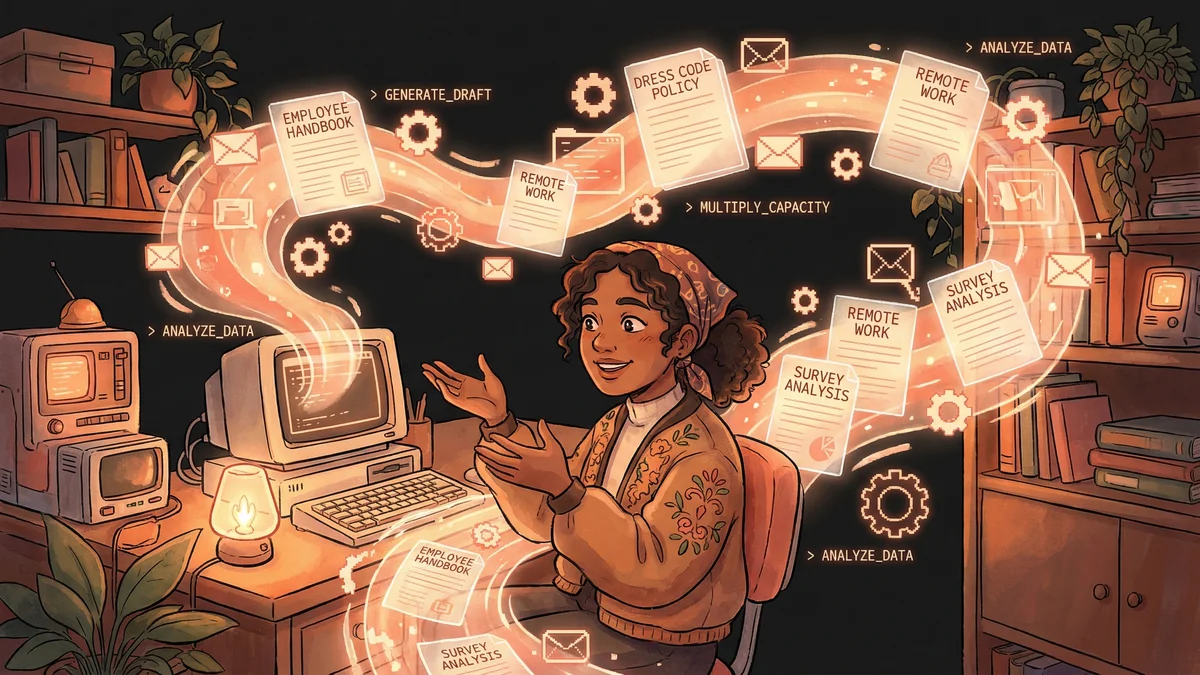
Maria decided to test the approach on an entire handbook.
The client: a 20-person professional services firm. The deliverable: a comprehensive employee handbook covering everything from attendance to termination procedures.
Her process:
- List all required sections (she knew these from experience)
- For each section, prompt the AI with the client’s context
- Review and customize each AI draft
- Assemble into final document
Example prompts:
- “Write a time-off request policy for a professional services firm with flexible PTO”
- “Write a harassment policy that’s comprehensive but not overly legalistic”
- “Write a remote work policy that emphasizes trust and results over monitoring”
The AI generated drafts for each. Maria refined them, added client-specific details, ensured legal accuracy, and moved on.
Total time: 4 days. Previous time for comparable handbooks: 2-3 weeks.
She’d compressed weeks of writing into days. The quality remained high — she was still applying her expertise and judgment to every section. She just wasn’t starting from blank pages anymore.
The Client Response
The client was impressed. They’d expected a 3-week turnaround. They got 4 days.
“They kept asking if I cut corners. I hadn’t. Every section was reviewed, customized, legally vetted. I just did it faster.”
The speed actually increased perceived value. Fast delivery on a quality product signaled capability, not shortcuts.
Maria started factoring AI into her quotes. She could now deliver faster without lowering quality, which meant she could either reduce prices (winning more clients) or maintain prices (higher effective hourly rate).
She chose a middle path: slightly lower prices, faster delivery, more projects.
Result: 40% more client work in the same hours, without sacrificing quality or burning out.
The Survey Analyst
AI didn’t just help with writing. It helped with analysis.
Another client asked Maria to review 300+ employee survey responses and identify culture issues. The traditional approach: read every response, manually code themes, write up findings.
“It would have taken me a full week just to read and categorize everything. Then more time to synthesize.”
She fed the responses (anonymized) into Notion AI and asked for a thematic summary.
The AI returned: “Common themes include communication gaps between departments, concerns about workload distribution, and requests for clearer career development paths.”
Was this sufficient on its own? No. But it gave her a map.
She knew where to focus her deep reading. She could validate the AI’s themes against specific responses. She could surface patterns she might have missed by reading one response at a time.
Analysis time: cut roughly in half.
The Email Assistant
Maria also struggled with email volume.
Clients sent long messages with multiple questions embedded. Writing thoughtful responses took time. But slow responses made clients feel ignored.
She added an AI email assistant to Gmail. When she received a multi-part email, she could click “Draft Reply” and the AI would generate a paragraph-by-paragraph response addressing each point.
“The drafts weren’t perfect. But they were structured. Each question got an answer. I just edited for accuracy and tone.”
Her email response time dropped. Clients noticed.
“Maria always responds quickly” became part of her reputation. What they didn’t know: AI was writing the first draft of those quick responses.
The Capacity Multiplier
Within six months of integrating AI, Maria’s business transformed.
She took on two additional ongoing clients without extending her working hours.
She increased her income by roughly 40%.
She felt less stressed because she wasn’t constantly fighting deadlines.
“I used to turn down projects because I was at capacity. Now I take them on because the AI extends my capacity.”
The math was straightforward. If AI saves 2 hours on a 10-hour project, that’s 20% more time available. Across dozens of projects, those hours compound into entire additional clients.
The Quality Guard
Maria was careful about where AI fit and where it didn’t.
AI handled:
- First drafts of standard policies
- Initial categorization of large data sets
- Email response structures
- Research summaries
Maria handled:
- Legal accuracy and compliance
- Client-specific customization
- Strategic recommendations
- Sensitive conversations
“AI can’t advise a founder on how to handle a difficult termination. It can’t read the room in a tense meeting. It can’t apply judgment about what a specific workplace culture will accept.”
Her expertise remained essential. AI just removed the mechanical parts of the job — the blank-page writing, the repetitive formatting, the initial sorting — so she could spend more time on the expert parts.
The Solo Enterprise
Maria still works alone. No employees, no contractors, no office.
But she delivers at a pace that used to require a small team.
“I feel like I have a junior associate who handles research and first drafts. Except the associate never needs training, never takes vacation, and never makes the same mistake twice once I correct it.”
Her clients get enterprise-quality deliverables from a solo consultant. Fast turnaround. Comprehensive coverage. Professional documentation.
“They’re not paying for AI. They’re paying for my expertise. The AI just lets me apply that expertise to more problems.”