TL;DR
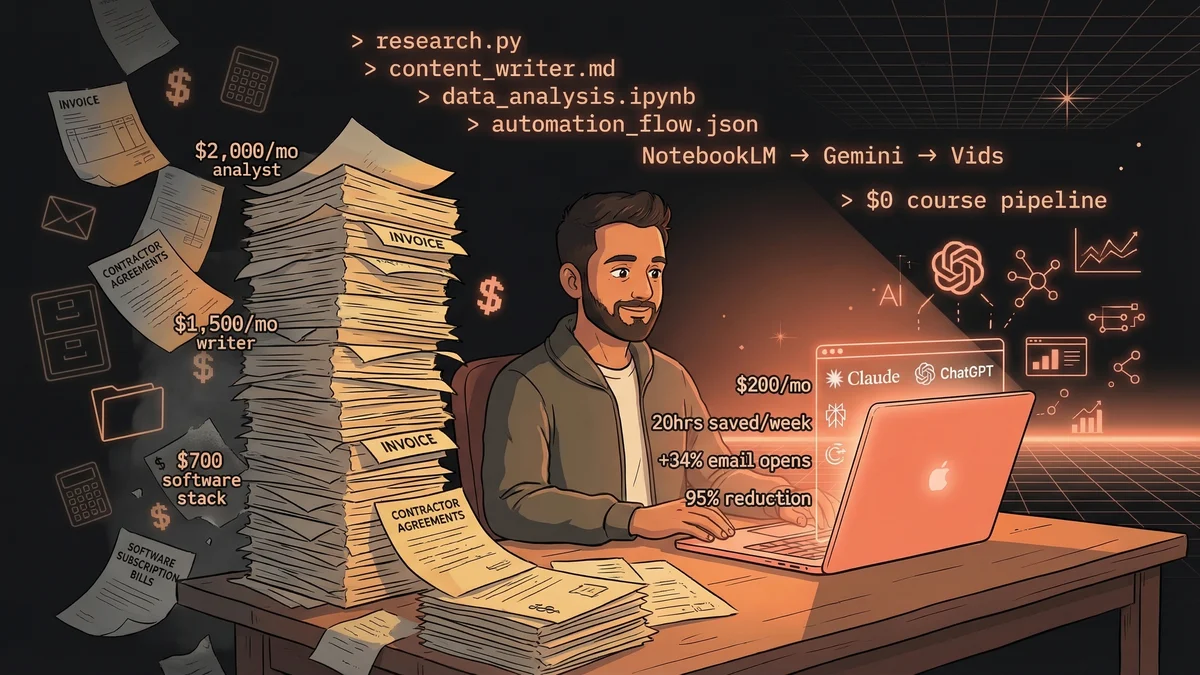
- Sam cut business costs from $4,200/month to $200/month using Perplexity Pro, Claude, ChatGPT, and automation tools
- Replaced a $2K/month junior analyst, $1.5K/month freelance writer, and multiple SaaS subscriptions
- Saved 20 hours/week while improving email open rates by 34%
- Xuebin built a zero-cost course creation pipeline using NotebookLM, Gemini Canvas, and Google Vids
- Both show the same pattern: AI-first infrastructure eliminates recurring costs
- Best for: Small business owners paying contractors or expensive SaaS for research, content, data analysis, or course creation
- Key lesson: The subscription model made sense when software was the only option; AI rewrites the economics
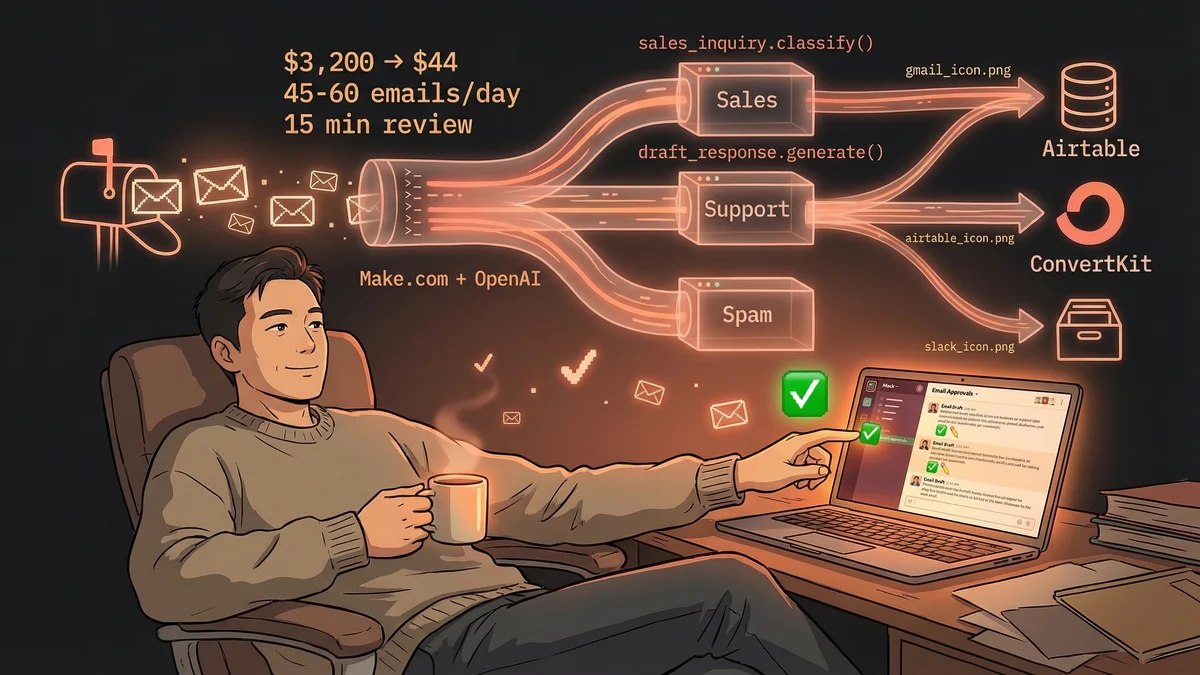
Sam paid $4,200 every month for software and contractors until he realized he was renting capabilities AI could deliver for $200. Xuebin almost bought course creation software until he discovered Google’s free AI tools could do the same work.
Sam Siam runs a business. Every month, $4,200 disappeared into software subscriptions and contractor invoices.
A junior analyst at $2,000/month researched competitors, market trends, and customer data. A freelance writer at $1,500/month turned that research into content. Data analysis software, email marketing platforms, and automation tools added another $700.
It worked. But it cost more than his office lease.
Then he started experimenting with AI tools. Not to supplement his stack—to replace it.
The $4,000 Question
Sam’s hypothesis was simple: if AI could handle research, writing, data analysis, and automation, he could eliminate most of his recurring costs.
Step 1: Replace the analyst
Perplexity Pro ($20/month) took over competitive research, market analysis, and customer data synthesis. What used to take his junior analyst 15 hours per week now happened in minutes.
Step 2: Replace the writer
Claude ($20/month) plus a few frameworks he’d built himself replaced the freelance writer. The content quality matched what he’d been paying $1,500/month for.
Step 3: Replace specialized software
- Data analysis: ChatGPT Advanced Data Analysis handled cohort analysis that used to require dedicated software
- Email marketing: AI-generated subject lines and segmentation replaced his email platform
- Automation: Zapier AI and Gumloop ($160/month combined) eliminated manual workflows
The math:
- Old stack: $4,200/month (2 contractors + multiple SaaS tools)
- New stack: $200/month (Perplexity Pro, Claude, ChatGPT, Zapier AI, Gumloop)
- Reduction: 95%
But cost savings weren’t the whole story.
When Cheaper Performs Better
Sam’s email open rates went up 34% after switching to AI-generated subject lines and segmentation.
Not “stayed the same and saved money.” Improved by a third.
The AI approach analyzed his entire email list, identified behavioral segments he’d never considered, and generated subject lines tuned to each segment’s engagement patterns. His old email software couldn’t do that—it optimized for features, not outcomes.
He saved 20 hours per week. His business ran faster on $200/month than it did on $4,200.
The lesson: He wasn’t buying cheaper versions of the same tools. He was buying different capabilities that happened to cost 95% less.
The Zero-Dollar Course Factory
Xuebin Wei wanted to create video courses. The traditional path:
- Loom or Camtasia for screen recording: ~$300
- Slide design software or templates: ~$50-200
- Course hosting platform (Teachable, Kajabi, Thinkific): $30-150/month
- Video editing if you don’t do it yourself: $500+ per course
Instead, he built a pipeline using three free Google AI tools.
The workflow:
- NotebookLM (free): Upload research documents → AI generates structured course summary
- Gemini Canvas (free): Input research summary → AI creates slide outlines and presentation structure
- Google Vids (free): Import slides → add AI avatar narrator → generate complete video lectures
Time: Minutes, not days Cost: $0 Code required: Zero
The output: complete video courses with AI presenters, professional slides, and structured content—all from uploaded source material.
What’s Actually Happening Here
Both Sam and Xuebin made the same bet: AI-first infrastructure over software-first.
The traditional model:
- Hire specialists or subscribe to specialized software
- Pay monthly regardless of usage
- Stack costs as you add capabilities
The AI model:
- Use general-purpose AI for multiple functions
- Pay per capability, not per tool
- Costs stay flat as capabilities grow
Sam’s Perplexity Pro subscription ($20/month) does the work of a $2,000/month analyst. His Claude subscription ($20/month) does the work of a $1,500/month writer. He’s not paying for research software and writing software—he’s paying for intelligence that can research and write.
Xuebin’s course creation pipeline costs nothing because Google is subsidizing access to models that can handle research synthesis, slide design, and video generation. He’s not paying for three separate software products—he’s using one AI stack that does all three jobs.
The pattern: When you pay for intelligence instead of features, the cost structure collapses.
The Part They Don’t Tweet About
Sam didn’t flip a switch and save $4,000 overnight.
He spent weeks testing AI tools against his existing workflows. Some tasks worked immediately. Others required building custom frameworks and teaching the AI his business context.
The freelance writer didn’t just write—they understood his brand voice, his audience, and his content goals. Claude needed those same things explicitly documented before it could match the output quality.
The junior analyst had domain knowledge built up over months. Perplexity Pro needed carefully structured prompts to pull the right competitive intelligence.
The investment: time learning how to structure AI workflows The payoff: $4,000/month in perpetual savings
Xuebin’s zero-dollar pipeline isn’t zero-effort. NotebookLM needs well-organized source documents. Gemini Canvas needs clear direction on slide structure. Google Vids needs properly formatted slides to work with.
But once you learn the workflow, it scales infinitely at the same zero cost.
What This Means for Your Stack
If you’re paying for:
- Junior analysts or researchers → Try Perplexity Pro ($20/mo)
- Freelance writers → Try Claude ($20/mo) with documented frameworks
- Data analysis software → Try ChatGPT Advanced Data Analysis
- Email marketing platforms → Try AI segmentation + subject line generation
- Course creation tools → Try NotebookLM + Gemini Canvas + Google Vids
The question isn’t “Can AI do what this tool does?” The question is “Can AI do what I’m actually paying for?”
Sam wasn’t paying $2,000/month for a human to exist. He was paying for 15 hours of competitive research per week. When Perplexity Pro delivered the same research in minutes, the human became optional.
Xuebin wasn’t paying for Camtasia’s features. He was paying to turn content into video courses. When Google’s AI tools delivered the same outcome for free, Camtasia became unnecessary.
The economics shifted. Intelligence is now cheaper than software.
The Pattern
- Identify what you’re actually buying (outcomes, not job titles or feature lists)
- Test if AI can deliver that outcome (invest time in setup and learning)
- Replace the most expensive items first (biggest ROI)
- Measure performance, not just cost (Sam’s email opens went up 34%)
Sam went from $4,200/month to $200/month and his business runs better.
Xuebin went from planning a $500+ investment to building a $0 course factory.
Neither are paying for software anymore. They’re paying for intelligence.
And intelligence just got 95% cheaper.