Something shifted in February 2026. Across industries, business owners started reporting the same experience: their AI tools weren’t just helping anymore. They were deciding, executing, and managing—often better than the humans they replaced.
The 16x Productivity Paradox
Charlie, a 24-year-old finance analyst, documented his own obsolescence in real time. In early 2025, using an AI chatbot cut his 8-hour cash flow modeling work to 3 hours. Impressive, but still human-driven work.
Then came Claude for Excel. Type a simple question—“My data is on these tabs [x,y,z], can you produce a cash flow model for me?”—and receive a near-flawless model in return. The same work that once took 8 hours now takes 30 minutes of checking the AI’s output. That’s 16x faster in one year.
Charlie sees the business logic clearly: “There’s two routes a business can go from here: A) Keep same staff, quintuple output of work. B) Skinny up staff, provide 2x output of work. Option B is usually more economically efficient.”
He’s living the productivity trap: getting dramatically better at your job while simultaneously making your role unnecessary. When you don’t provide value a robot can’t match, he notes, “there’s going to be an increased sense of meaninglessness.”
The Digital Twin That Manages Your Team
Valentyn Yaromenko runs two companies on what he calls “real ops, no demos.” He’s explicit about hating the “I replaced McKinsey with a $20 Claude” posts flooding Twitter: “Most of them are just people playing with tools and farming likes.”
His stack is different. Google Gemini provides virtual C-level advisors that pressure-test every major decision. ClickUp Superagents leverage 8 years of company data—when the agents launched, they already had full context. But the real shift is Valbot, his digital twin.
Valbot doesn’t just schedule meetings or summarize emails. It runs his task layer and communicates with his team. Not “helps him communicate”—communicates. The agent represents him, makes decisions, and manages operations autonomously. He’s rolling out Claude + MCP integration to his tech and GTM teams next, calling it “the one keeping me up at night (in a good way).”
The throughline: AI stopped being advisory and became operational. His companies run on it.
The $210 Operations Team
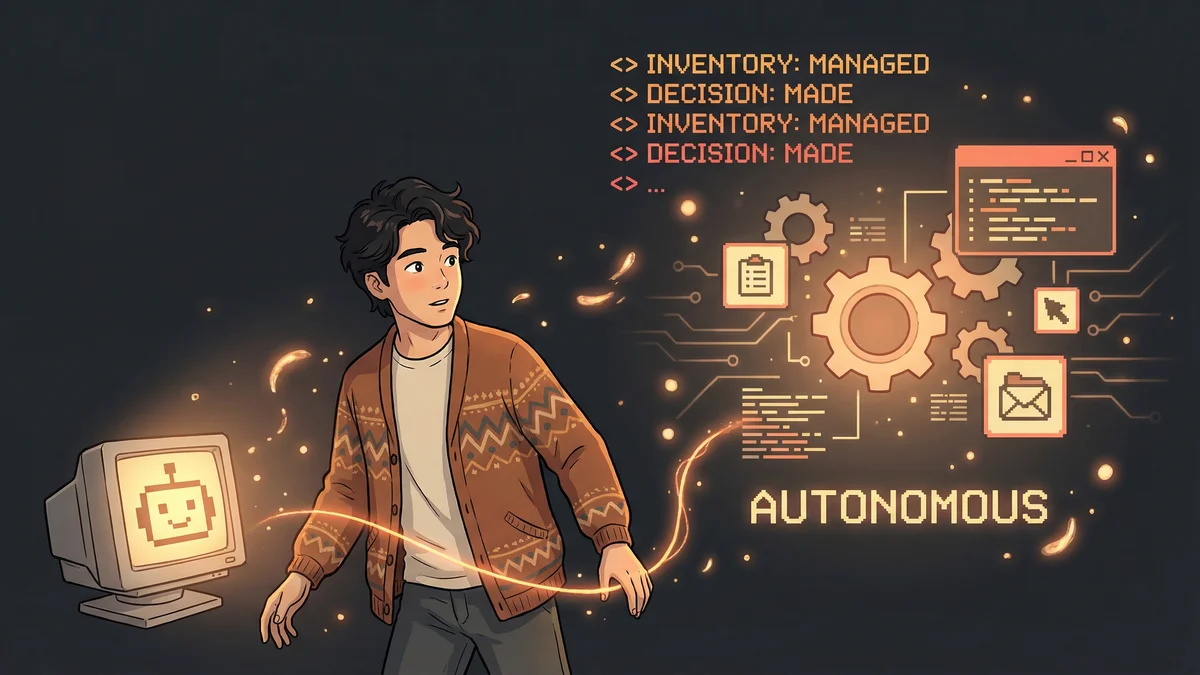
Matt Bender built an operations control center for his e-commerce businesses. Multiple AI agents manage Amazon/Walmart inventory, sales forecasting, content creation, customer outreach, ad management, and client success. Each agent operates in its own domain and reports to a central dashboard.
The telling phrase: “Still early but it’s already handling real decisions on its own.”
Not recommendations. Not suggestions. Decisions. Autonomous execution across inventory, advertising, and customer relationships. The cost? About $10/month plus a $200 Claude subscription. A full operations team for $210/month.
When asked about the economics, Matt confirmed: “I would say it’s pretty cheap… So far not expensive.” Another e-commerce seller commented, “building something similar as well.” This isn’t an experiment—it’s becoming the standard in online retail.
From Coding Tool to All-Purpose Employee
Ian Park discovered Claude Code worked for tasks far beyond its name. Making YouTube videos with Remotion. Web scraping. Article research. Instagram carousel design. Marketing automation. Not coding—business operations.
His insight: “If it can handle complex programming, repetitive one-off tasks are a joke.”
He’d been considering downgrading his Claude subscription—tokens were just sitting there unused. Then he realized what he actually had: “This is basically one all-purpose employee who never gets tired.”
The mental model changed. Not a tool. Not an assistant. An employee. And once you assign roles per agent, “it genuinely feels like you ‘hired’ a few specialists—one for each job.”
The Pattern
Four different people, four different industries, same inflection point. AI crossed from enhancement to replacement. From helping humans work to executing the work itself.
Charlie’s two-phase evolution shows the trajectory: chatbots made him 2.7x faster, native tool integration made him 16x faster. Valentyn’s digital twin manages his team. Matt’s agents make business decisions autonomously. Ian stopped seeing a tool and started seeing employees.
The throughline isn’t just productivity—it’s autonomy. AI that requires oversight rather than direction. Systems that execute rather than assist. Digital workers that operate independently while you sleep, travel, or focus elsewhere.
We’re past “AI helps you do your job faster.” We’re into “AI does your job while you figure out what’s next.”