TL;DR
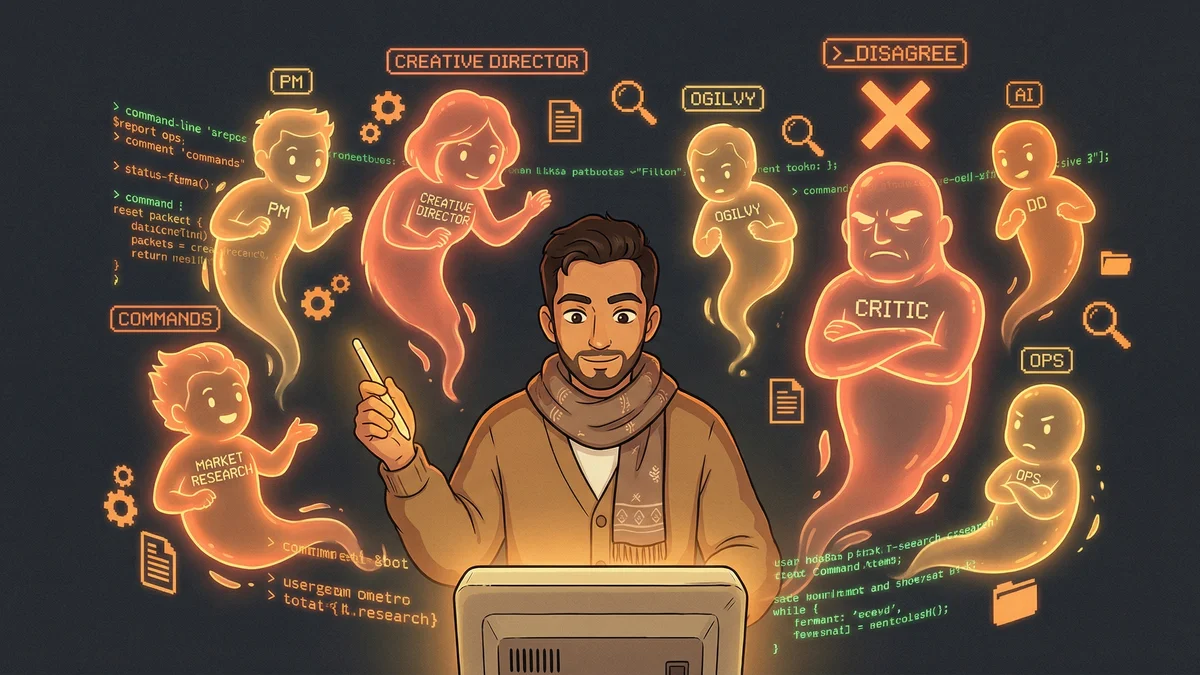
- Former NYC brand agency owner rebuilt his 8-person team as AI agents — PM, Creative Director, Critic, Copywriter (“Ogilvy”), Market Research, and Ops
- The agents produce brand strategies autonomously in hours, with minimal human intervention
- The secret weapon: a critic agent whose only job is to disagree. Without it, you get an echo chamber.
- The output isn’t just for humans — agents write briefs for other agents
- Best for: agency owners, consultants, anyone with deep domain expertise to encode
The moat isn’t “I use AI.” It’s “I built an AI workforce that thinks like my best people.”
That quote, from someone watching this unfold on Twitter, captures something most AI projects miss entirely.
The Setup
Assaf Dagan ran a brand agency in New York City. He knows how agencies work — the roles, the handoffs, the creative tension between people who dream big and people who keep things realistic. When he decided to rebuild that agency as AI agents, he didn’t ask “what can AI do?” He asked “what did my team actually do, and how?”
The answer was 8 agents, built on OpenClaw:
| Agent | Role | What It Does |
|---|---|---|
| PM | Project Manager | Coordinates workflow between agents |
| Creative Director | Vision | Sets direction, reviews output |
| Ogilvy | Copywriter | Writes brand copy (yes, named after David Ogilvy) |
| Critic | Quality control | Challenges every output |
| Market Research | Intelligence | Analyzes competitors and positioning |
| Ops | Operations | Manages logistics and deliverables |
| + 2 more | Specialized | Domain-specific roles |
Dan Peguine, who shared the system, used it to critique his own product dashboard. He fed it in, and the 8-agent team produced a complete brand strategy — plus an “engineering agent brief” he could hand directly to a coding agent for implementation.
“They developed a brilliant strategy with almost no intervention.”
The Part Everyone Misses: The Critic
Here’s where this gets interesting. Most people building multi-agent systems skip adversarial feedback. Everyone agrees with everyone. The Creative Director proposes a direction, the Copywriter writes it up, the PM schedules it. Sounds efficient.
It’s also how you produce mediocre work.
As one observer noted:
“The fact that the critic role exists is what makes this work — most people skip adversarial feedback in their agent setups and end up with echo chambers that produce mediocre output.”
The Critic agent’s entire job is to push back. To find the weakness in the strategy. To ask “is this actually good, or does it just sound good?” That tension — the same tension that makes real agencies produce better work than freelancers — is what separates this from a ChatGPT prompt.
Agents Writing for Agents
The other breakthrough is subtle but important: the output isn’t always meant for humans.
When the brand agency finishes a strategy, it produces an “engineering agent brief” — a document formatted specifically for a technical agent to pick up and implement. Agent-to-agent handoffs. The human doesn’t need to translate between creative strategy and technical execution.
“That’s the unlock — agents that output work for other agents, not just for humans.”
This is where multi-agent systems stop being “chatbots in parallel” and start being actual workflows.
What This Means for You
You don’t need to have run a brand agency. The pattern is transferable:
If you have deep domain expertise — years of knowing how work flows in your field — you can encode it into agent roles. The value isn’t in the AI. It’s in your knowledge of who does what, in what order, and what “good” looks like.
The 20+ companies in the replies asking for a trial aren’t interested because it uses AI. They’re interested because someone who actually knows branding built it.
That’s the difference between a tool and a solution.
-> Source