TL;DR
- Sherman asked Claude to check his construction invoices and caught a $2,646 double-billing on plumbing labor
- Tushar used Claude to design a ₹400 gravity-drain honey frame, replacing ₹30,000 spinning extractors for Indian beekeepers
- Both cases show the same pattern: ask AI before spending money
- Best for: Anyone reviewing invoices, quotes, or considering expensive purchases
- Key lesson: The question costs nothing; the answer can save thousands
Two people asked AI to check their bills before paying. One caught a $2,646 overcharge. The other designed a 75x cheaper alternative to equipment he almost bought.
Sherman Dangerfield stared at the third invoice from his brick-and-mortar construction contractor.
He’d already paid two invoices. This third one felt high, but construction always costs more than you expect. He almost signed the check.
Then a thought: “Let me ask Claude to look at this.”
The $2,646 Question
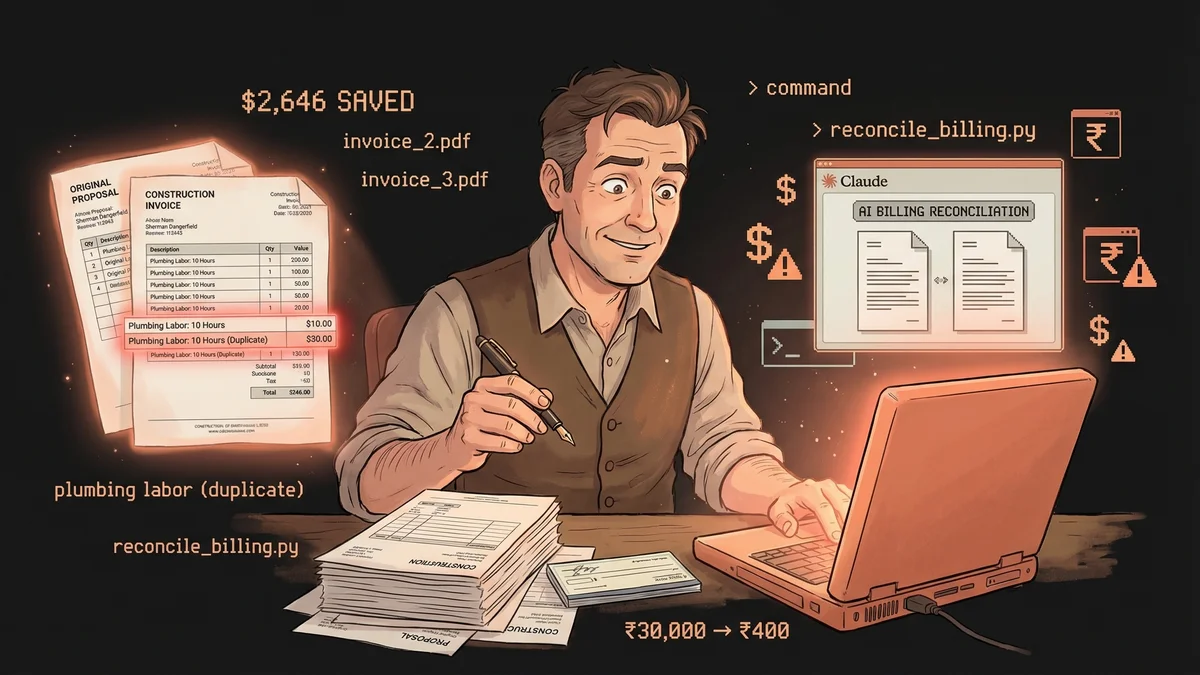
Sherman uploaded four documents to Claude: the original construction pricing proposal and all three invoices — the two he’d already paid plus the current one.
His prompt was simple: “Reconcile these invoices against the original proposal.”
Claude’s response was not simple.
Plumbing labor had been billed twice — once on invoice #2, again on invoice #3. Same work. Double charge. $2,646.
Sherman shared the finding on X: “Finally found a very practical application for AI.”
The replies came from commercial real estate professionals and construction industry veterans. They’d all been there. Contractor billing errors aren’t malicious — they’re common. Projects span months. Line items get duplicated. Mistakes happen.
But $2,646 mistakes hurt.
Sherman’s check to the contractor was $2,646 lighter. His faith in AI got stronger.
The ₹30,000 Answer
Seven thousand miles away in India, Tushar Singh Kothari had a different problem.
Indian smallholder beekeepers face a barrier: honey extraction equipment costs ₹30,000 (roughly $360). For farmers working tiny plots, that’s impossible.
Traditional extractors work by centrifugal force — you spin the honeycomb frame inside a drum, honey flies out, gravity drains it. The spinning mechanism is what costs money.
Tushar asked Claude: “Can we eliminate the spinning?”
Forty minutes of back-and-forth later, they had a design.
A gravity-drain frame made of polypropylene. No spinning. No motor. Just physics. Cost: ₹400.
“This changes everything for smallholders,” Tushar wrote, sharing photos of the design. Claude hadn’t just helped him save money — it had helped him solve a “complex physics” problem that democratized technology for farmers who’d been priced out.
The beekeeping frame wasn’t a software hack. It was mechanical engineering, materials science, and agricultural economics rolled into one design iteration.
Claude handled all of it.
The Pattern: Ask Before You Pay
Two different continents. Two different industries. Two different problems.
Same solution: Ask AI before the money leaves your account.
Sherman didn’t need to become an accountant. He just needed to compare four documents. Claude did the cross-referencing, spotted the duplicate line item, and flagged it.
Tushar didn’t need an engineering degree. He needed a design that used gravity instead of motors. Claude iterated on the physics, fixed errors in the design, and delivered a spec buildable for ₹400.
Neither case required technical expertise from the human. Both required asking the right question at the right time.
What This Means for You
If you’re about to:
- Pay a contractor invoice
- Accept a vendor quote
- Buy expensive equipment
- Sign a recurring software contract
- Approve a service billing
Ask AI first.
Upload the documents. Ask it to check. Ask if there’s a cheaper way. Ask if the math adds up.
The question costs you nothing. It takes two minutes.
The answer might save you $2,646. Or help you build something 75x cheaper. Or confirm everything is correct and you can pay with confidence.
Sherman’s framing says it all: “Finally found a very practical application for AI.”
It’s not about agents or automation or autonomous systems.
Sometimes it’s just about asking, “Is this right?” before you write the check.