TL;DR
- Charles gets a full financial review by uploading his expense CSV to Claude Projects
- Rahul uses a cafe notebook and SOP writing to delegate any task to AI
- Oge’s AI system calls leads, qualifies them, sends proposals, and books meetings automatically
- Best for: non-technical business owners who’ve been told AI is too complex for them
- Key lesson: The expensive helpers you couldn’t hire exist as software subscriptions you already own.
Financial advisors charge $300/hour. Operations consultants charge more. Sales reps need salaries, benefits, and training. A lot of small business owners just go without.
That math is changing. Three business owners are now covering roles they couldn’t afford to fill — not with complex custom systems, but with tools most people already pay for.
The Financial Advisor (No Appointment Required)
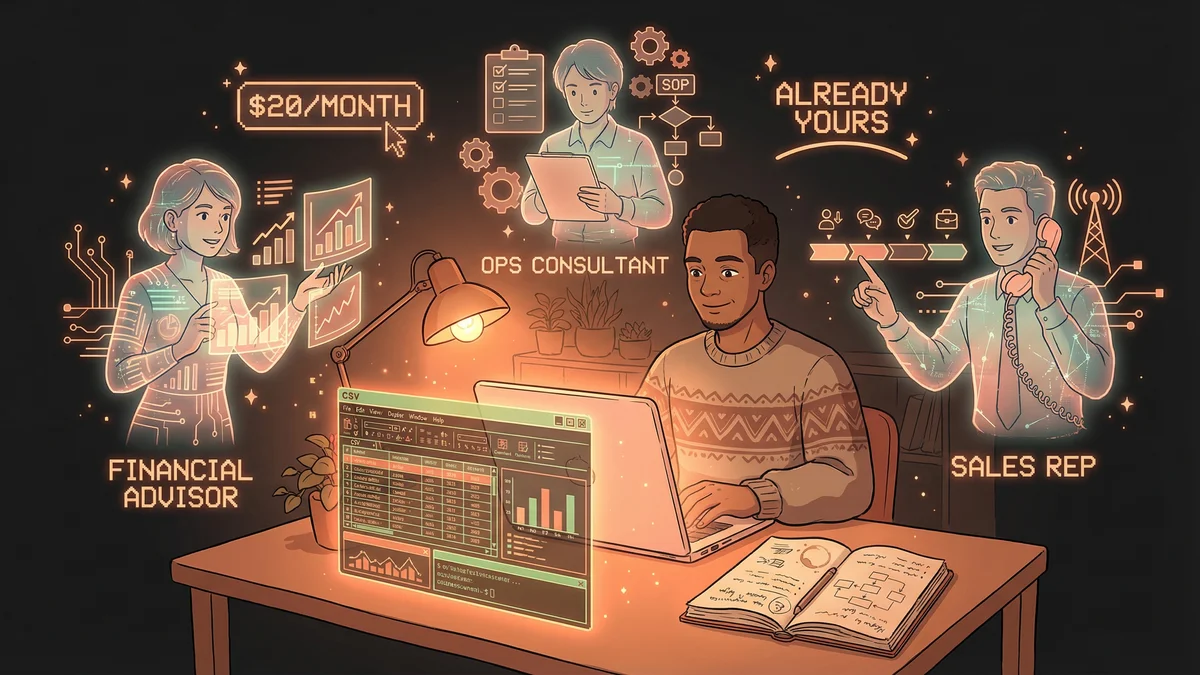
Charles Janoah Policarpio doesn’t schedule quarterly reviews with a financial advisor. He opens a Claude Project.
The workflow takes five minutes: export monthly expenses as CSV from your banking app, open a new Project in Claude or ChatGPT, set the system prompt to “you are my personal finance advisor — identify spending patterns and flag anything I should cut,” and upload the CSV.
What comes back: a high-level summary of where money is going, month-over-month comparisons, and the “hidden leaks” — subscriptions that crept up, category overspend, and outlier charges that blur together in a long statement.
“Great way to get a high-level look and cut hidden leaks,” Charles noted. No appointment. No hourly rate.
Takeaway: Any expense app with CSV export gives you 80% of what a basic financial advisor review costs $300 to provide — if you point AI at it.
The Operations Consultant (The Cafe Notebook Method)
Rahul Dev’s framework starts before AI enters the picture.
Step one: sit at a cafe with a notebook and write down the tasks that, if done consistently, would actually move your business. Not the urgent inbox. The important recurring work.
Step two: for your top one or two tasks, write an SOP — every step, every decision, written out as if training a new team member who knows nothing. Be specific enough that the process could run without you.
Step three: give the SOP to Claude or ChatGPT with one question: “Automate 80–90% of this. Should I use an automation tool (Make/Zapier/n8n), an AI agent, or a digital employee?”
The question of which AI tool to use gets answered by the SOP itself. Complex branching decisions point toward agents; linear repeating steps point toward automation. The SOP-first approach removes the guesswork that trips most people up.
Takeaway: Most AI automation projects fail because people skip the SOP step. The cafe notebook costs nothing and makes everything else work.
The Sales Rep (Works the Night Shift)
Oge built a system that never takes a lunch break.
When a new lead fills out a form, the system reads it from Airtable, qualifies them based on budget and intent signals, places an AI voice call, holds a conversation, and sends a tailored proposal by email. If the lead is interested, it books the meeting via Calendly and pings the sales team on Slack with full conversation context.
No human touched the lead from form submission to qualified meeting slot.
“Most businesses don’t have a lead problem,” Oge observed. “They have a response and follow-up problem.” The system solves exactly that — leads get a response in seconds instead of the next business day.
Takeaway: The bottleneck in most sales pipelines isn’t generating leads — it’s responding fast enough to convert them. AI closes that gap completely.
The Pattern
None of these required a developer. Charles uses a CSV and a project prompt. Rahul uses a notebook and a single question. Oge built in Make and Airtable — both drag-and-drop tools.
The common thread: each person identified one expensive function they couldn’t staff, then found the minimum viable AI to cover it. Not a complete transformation. One job. One workflow.
The financial advisor, the ops consultant, the sales rep — they’re not gone. But they’re no longer the only option.