TL;DR
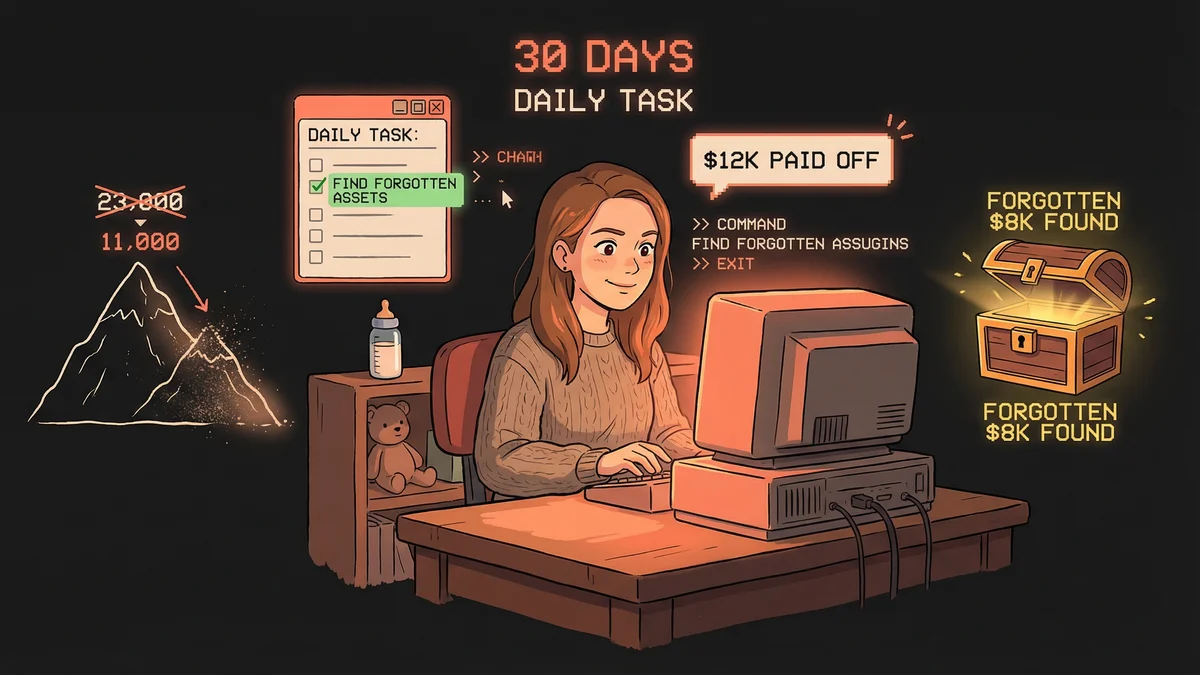
- Woman reduced $23,000 debt by $12,000 in 30 days using daily ChatGPT tasks
- AI suggested checking forgotten accounts - she found $10,200 in a dormant brokerage
- System: Ask ChatGPT for one specific 30-minute financial task each day, then do it
- Best for: People overwhelmed by debt who need shame-free, micro-step guidance
- Key lesson: Discovery-oriented tasks (finding money you have) work better than sacrifice-focused advice
A woman paid off $12,000 of credit card debt in 30 days by asking ChatGPT for one simple daily task - including one that uncovered $10,200 in a forgotten brokerage account.
Jennifer was $23,000 in credit card debt after having a baby.
The hospital bills. The supplies. The months of reduced work. It added up in ways she couldn’t control.
She felt crushed by it. The shame. The interest accumulating. The sense that she’d somehow failed at adulthood.
Traditional advice said: make a budget, pay more than the minimum, maybe call a financial advisor.
Jennifer did something different. She asked ChatGPT to help her - not just with the math, but with the daily grind of climbing out.
The Daily Prompt
Jennifer created a simple routine:
Every morning, she opened ChatGPT and asked:
“I’m in debt and trying to improve my finances. Give me one specific task I can do today to make progress.”
Not general advice. Not a comprehensive plan. One task. Today.
The AI responded differently each day:
Day 1: “Check if you have any automatic subscriptions you’ve forgotten about. Log into your bank account and review recurring charges from the past 3 months.”
Day 3: “Search ‘[your state] unclaimed property’ and check if you have any unclaimed money. It takes 5 minutes.”
Day 7: “Call your credit card company and ask if they can lower your interest rate. Use this script: ‘I’ve been a customer for X years and I’m considering balance transfer offers. Is there anything you can do to lower my current rate?’ The worst they can say is no.”
Day 12: “Review your old accounts: brokerage accounts, retirement accounts from previous jobs, savings accounts you might have forgotten. Many people have dormant accounts.”
Day 18: “Contact your internet/phone provider and ask for their current new customer rate. Threaten to switch if needed.”
Some tasks took 5 minutes. Some took an hour. All of them were specific enough that she could actually do them.
The Forgotten $8,000
Day 12’s prompt changed everything.
Jennifer had a vague memory of a brokerage account she’d opened years ago with a small inheritance. She’d forgotten the exact institution, but the AI task pushed her to dig through old emails.
She found it. The account had grown to $10,200.
That wasn’t the AI “finding money” - Jennifer knew the account existed, sort of. But she’d never connected it to her debt situation. The daily prompt forced action on something that had been sitting in the back of her mind for years.
She transferred the money that week and paid off her highest-interest card in full.
The Psychology That Worked
Why did this approach succeed where traditional debt advice failed?
1. Non-judgmental interaction
Human advisors, even good ones, carry implicit judgment. Jennifer felt shame about her debt. Talking to a person about it felt awful.
ChatGPT didn’t judge. It didn’t sigh. It didn’t give her “that look.” It just gave the next task.
“This sounds silly,” Jennifer says, “but I could be completely honest with the AI about how bad things were. I couldn’t be that honest with a person.”
2. Micro-progress over macro-plans
Most debt advice is big-picture: here’s a 3-year payoff plan, here are the numbers.
Jennifer found that overwhelming. The numbers were so large that seeing them laid out made her want to hide.
The daily task approach kept her focused on today. One thing. Completable before dinner.
3. External structure without external judgment
She’d tried tracking apps before. She’d see the dashboard, feel terrible, close the app.
ChatGPT didn’t maintain a dashboard. It didn’t show her the scary total. It just gave the next instruction. The structure was external (not relying on her own willpower) but didn’t trigger shame spirals.
4. Discovery-oriented
Many tasks weren’t about spending less. They were about finding resources she already had.
Forgotten accounts (the $10,200 brokerage). Better rates she’d never asked for. Reduced spending she hadn’t noticed.
This reframed debt payoff from “suffer and sacrifice” to “treasure hunt for your own money.”
The 30-Day Results
In one month, Jennifer:
- Found $10,200 in a forgotten brokerage account
- Negotiated credit card interest from 24% to 17%
- Cancelled $89/month in unused subscriptions
- Got $40/month off her cable bill
- Identified $1,400 in potential tax deductions for next year
Total debt impact in 30 days: approximately $12,000 reduced (through found money and avoided interest).
She didn’t hit zero debt. But she went from $23,000 to approximately $11,000, and the remaining debt was now at a lower interest rate.
The Prompts That Worked Best
Jennifer refined her approach over time. These prompts generated the most useful responses:
The Daily Task: “I’m working on paying off debt. Give me one specific, actionable task I can do today in under 30 minutes.”
The Reality Check: “Here’s my current budget: [paste breakdown]. What am I missing that could be reduced or eliminated?”
The Negotiation Script: “Write a phone script for calling [company] to ask for a lower rate. Include what to say if they initially refuse.”
The Motivation: “I just paid off [X]. Give me a quick pep talk and remind me why I’m doing this.”
The Scenario: “If I put an extra $200/month toward my credit card at 17% interest, how much faster will I pay it off?”
What the AI Couldn’t Do
ChatGPT was helpful but not magic. Important limitations:
It couldn’t access her accounts. Jennifer had to manually pull data and paste it. The AI worked with what she gave it.
It sometimes gave generic advice. When Jennifer asked for super-specific guidance, the AI occasionally defaulted to “consult a financial professional.” Fair, but frustrating.
It didn’t know current rates. When asking about “best” balance transfer offers, the AI’s knowledge was dated. She had to verify offers herself.
It couldn’t make her do the work. Some days she didn’t feel like making that phone call. The AI suggested the task; following through was still on her.
The Accountability Loop
Jennifer realized the real value wasn’t the advice - it was the accountability structure.
She started each day with a commitment: ask the AI, do the task.
That external prompt created a tiny bit of obligation. Not to another person, but to the process itself.
Some days the task was trivial (check a single account balance). Other days it required courage (call a creditor and negotiate). But every day, she did something.
Progress became a habit, not a heroic effort.
Beyond the 30 Days
Jennifer didn’t stop after a month. She adjusted the frequency:
- Daily prompts for the first 30 days (crisis mode)
- Weekly prompts once momentum built
- Monthly check-ins once she had systems in place
She’s now 8 months in. Remaining debt: $2,400. On track to be debt-free within 3 months.
“The AI didn’t pay my debt. I did. But it kept me pointed in the right direction when I wanted to give up. It gave me something to do instead of just feeling horrible about numbers.”
The Replicable System
Jennifer’s approach can be copied:
- Set a daily reminder to open ChatGPT (or Claude)
- Use a consistent prompt: “Give me one specific financial task for today”
- Do the task - however small
- Log results (even just in a notes app)
- Adjust frequency as you build momentum
- Combine with traditional tools (debt tracking apps, spreadsheets) for the full picture
The AI provides structure and ideas. You provide the action. Together, it works.